
Summer 2026: Looking for (My) Life ~~ Page 1, Poems
Our summer issue is full of great poems.
(The picture is of a beech tree with initials carved in the bark; photo by Charles A. Swanson)
Table of Contents - Page 1

1. Melanie Faith ~~ Photograph on Left
Spools of Thread
2. April J. Asbury ~~ Two Poems
"Victorian Trading Company Has Closed"
"The Lavinia Tree"
3. Sean Whalen ~~ Three Poems
"The River and the Trees"
"County Blacktop Nirvana"
" Recycled"
4. Becky Parker ~~ Two Poems
"The Art of Thou"
"Attached Ponds"
5. Melanie Faith ~~ Poem
"Children Play Tornado"
6. Tyson West ~~ Two Poems
"Sunday Afternoons with Lyssa"
"Deliverance"
7. Sherry Poff ~~ Two Poems
"Time Held Me"
"(At the Car Wash)"
8. Elizabeth Hykes ~~ Two Poems
"I am Elisabetta "
"Patched wingtips"
9. Mantz Yorke ~~ Poem
"Woman in Blue"
10. Wendy Howe ~~ Two Poems
"Capistrano"
"After The Virus Came"
11. Benjamin Chitambira ~~ Two Poems
"The Desert in Him"
"Butterfly"
12. Vivian Finley Nida ~~ Poem
"Epiphany"
More Poems
Melanie Faith ~~ Photograph on Left
Iris
13. Howard F. Stein ~~ Two Poems
"In Search of Life"
"Sameday"
14. Wilderness Sarchild ~~ Poem
"Directions"
15. John C. Mannone ~~ Two Poems
"Seeking Solace"
"Black & White"
16. Arvilla Fee ~~ Poem
"When the World Presses"
17. Sharon Waters ~~ Two Poems
"In Here"
"Easter Arrives"
18. Linda Vigen Phillips ~~ Poem
"When the Muse Allows"
2. April J. Asbury
Two Poems
Victorian Trading Company Has Closed
And where will I buy my lace socks now? My brass candlesnuffers?
Where will I find solitary teacups, rhinestone-honeybee pins,
cherub Valentines? My mailbox needs those catalogues
to veil the curt water bills and gaudy mattress ads,
to twine the crude and crass in violets, ivy, ornate
calling-card script. I regret passing over the felt
cloche hats, gilt-edged sugar-bowls, silver tongs,
stationary flushed pink with chubby cabbage roses.
I lament lacking cash for the brass-and-marble fireplace,
the sumptuous fainting couch in rich burgundy velvet.
I will not buy such things from Amazon, even if they should appear
next to the burrito blankets and detachable mullets. Even with money
enough to buy fripperies and fineries, gewgaws and gimcracks,
bijoux and bagatelles, I will not support the monster
who robbed me of my parchment-colored dreams.
*****
The Lavinia Tree
“. . . what stern ungentle hands
Have lopp'd and hew'd and made thy body bare
Of her two branches . . .?”
Marcus, on seeing his niece Lavinia (Titus Andronicus 2.4)
The lovely tree in the memorial garden
held her secrets, and I do too. Brittle, crooked,
we split with wind and soften with fungus; we lived
through poisons and parasites, witch butter and blight.
But the lovely tree bloomed and bore leaves anyway,
until they lopped off her branches. She was gone in a day.
O how sad, said the men who stopped to watch.
O what a shame, they said. Heart rot--
can’t be stopped and can’t be saved.
Maybe she couldn’t and maybe I can’t,
but I will stretch my rotten fingers to the sun
and I will grow anyway. My life, my corrupted sap,
defies knives and saws and concerned men
as I hide my soft dark core.
About the Poet: April J. Asbury teaches writing and literature at Radford University, where she co-directs the Highland Summer Conference. She earned her M.F.A. from Spalding University and M.A. from Hollins. Her poetry and fiction appear in Artemis Journal, Still: The Journal, Gyroscope Review, and The Anthology of Appalachian Writers. Woman with Crows, her first poetry collection, is available on apriljasbury.com.

Sheep by Side of Road; Photograph by Anna Crawley
3. Three Poems by Sean Whalen
The River and the Trees
At my age I hope I’ve just disturbed the surface.
I expect to find another year hiding under every rock I pick up,
spare seconds to accumulate like leaves raked into piles,
five more minutes to be gifted by every flock of birds.
But I know better. Brain and heart are in agreement –
what is looked for might not be.
Yesterday a March blizzard turned the house into an island.
This morning I trudge out, fill the feeders and water bowl, buy the birds
a little more time to adjust from sunny sixties to cloudy six below.
What was the cost?
Nothing consequential –
five minutes, a handful of thistle, a bucket of corn, a few flakes of exposed skin
chipped away by the north gale and deposited in the drifts of new snow.
In a few days, given the tilt of the earth, we will melt and flow,
add to the flooded creek and river. And so away.
Tomorrow the trees will have forgotten the wind, the river the ice.
Today I pledge to be more like the river and the trees,
accept the bends and swirls of current, let rocks be undefinable,
forgive the birds for being unable to give what they cannot give.
Trees grow despite missing leaves that have gone.
The river flows regardless of water that may not come.
******
County Blacktop Nirvana
I wander for miles where green cracks weave a net
in accidental arteries carved by water and ice.
There is emptiness to accept, raw sun to embrace.
I lock the free breeze off the fields in the bin of my mind,
lean into the caress of butterfly wings on my cheek,
transcend the buffeting of a rare gust cast
by a lonely truck traveling from nowhere to nowhere,
the passage of tires and time indifferent to walker or weeds.
*****
Recycled
I’m searching an exposed ancient campsite
hiding in the rows of an Iowa corn field
plowing and pounding rain resurrect stone artifacts, a reminder
to the living someone may search for them as well someday
where people I’ll never meet had their homes, but all I find are small bones,
not old, not new, bright white, scrubbed clean
and not just a few but so many uncountable splashed over the entire field,
I understand they add vitality to the soil
an uncomfortable discussion
of tiny ribs, jaws, legs, scapulas,
skulls broken by the disc into individual plates.
Witness the fracturing of the universe.
In a nearby hog confinement the squealing of pigs augments
the woodland warbling of orioles and the warning cry of jays,
who make no assumption of good
and I realize I am walking with the remnants of lost litters
spread with the manure to feed the corn to feed the sows to feed me,
ad infinitum
so I decide then and there that in my last will and testament I will request
to be dropped into the slurry pit under the confinement, liquify,
it takes a surprisingly short amount of time
because what could be a better end
than to have my juices sprayed in an arc,
cast a dirty rainbow
my skeleton flung to the sky across this final resting place
of forgotten families and future feasts.
Poet’s Notes: I bought Maugham's Of Human Bondage over eleven years ago at the Goodwill store in Fort Dodge, Iowa (the receipt was a bookmark). One of my retirement goals was to write poetry, and have time to read through the stacks of books accumulated in the corner. I finally got around to Maugham, and as I prepared these poems for Flowers I was intrigued with the connection the main character, Philip Carey, had with Charles' selected theme. Looking for (his) life structures the entire novel. I was also struck by the parallels I felt with Carey, especially when he was foolish, noble, or questioning purpose, ability, and spirituality. It was the right book at the right time to prompt reflection, even at my age.
About the Poet
Sean Whalen is a retired health and safety professional from Pilot Mound, Iowa. He received his MA from Iowa State in Creative Writing. Read recent poems in Smoky Blue, Unbroken, New Feathers, Thimble, Gyroscope, Songs of Eretz, Canary, Men Matters On-line Journal, Naugatuck River Review, Waywords, Floating Acorn, Gilded Weathervane, Eastern Iowa Review, and Flowers of the Field. He looks for life in writing, outdoor activities, family, and house cleaning.
4. Becky Parker
Two Poems
The Art of Thou
Flecks of colors weave into a canvas
creating an abstract image. art.
Purples and reds elegantly strewn across a dusky sky
making the soul sigh. art.
Clay molded. Kiln fired. Painted and placed on a table. art.
Words crafted out of gossamer thought
and placed on a page. art.
Speeches soaring from orators across
a crowded stage that produces thunderous applause. art.
Hot buttered biscuits pulled from a
wood stove and dripping with gravy. art.
A dusty jeep nestled into white sand
in front of a turbulent ocean. art
Wrinkly arthritic hands cradling a wee babe
while a tired mother sleeps. art
Kind words in the midst of a cacophony of hate,
where it’s never too much or too late. art.
A warm coat offered to a needy child
who warms your heart with her smile. art.
An ear who listens without judgment or constraint. art.
How Great Thou ART
to grant discernment to see ethereal beauty
everywhere,
in a dappled sky, a droplet of dew,
in the common place, in the hard,
in the elevated, in a cherished friend
over and over and over and over again.
*****
Attached Ponds
I am two ponds,
attached capillaries of wild ferns
and lilies wild blooming on concrete embankments.
My body curves to the desk in the work jungle,
brain immersed in problems of state;
while my soul traipses through the quiet woods
nestled with deer, prancing among honeysuckle
bushes under a lemon sun.
About the Poet: Becky Parker is an award-winning writer who is published in Spirit Fire Review, Agape Review, Sweety Cat Press, Yellow Mama, Appalachia Bare, Lothlorien Poetry Journal, the Rye Whiskey Review, Pulse, the Green Shoe Sanctuary, Sequoyah Cherokee River Journal, Amaranth Journal, Spire Light, Avocet, Mackenzie’s Publication, Salvation South, Heart of Flesh, Mildred Haun Review, North Dakota Quarterly, Dog Throat Journal, 10x10 Flash Fiction, and others . She is the founder of Briar Haus Writes.
Small Creek Flowing Through Rock Outcrop; Photograph by Charles A. Swanson
Old Train Station; Photograph by Melanie Faith
5. Poem by Melanie Faith
Children Play Tornado
In Tornado Alley, children play tornado games. The term games is an understatement. They live the visceral fear of sirens, whose sound is eerily similar to that of air-raid sirens. They know the reflex to take shelter, often in the dead of night, in their printed pajamas, calling out and stumbling down stairs and scrambling around shadowy corners to a windowless bathroom, a cellar, or the laundry room. The mental marks from hours spent on the hard, cold floor, bringing in their blanket and their cat, their wary cat, to make a cozy nest, as cozy as can be with 4, 5, 6 keyed-up bodies curled up. Is that the sound of a real freight train or worse? Is the roof still on, out there in the rest of the dark house? They are very young, barely in school yet, but in daylight the next day they sit on the steps with their older sibling and pretend that their toy car, their action figure, or their plastic pony with a long, pastel mane, grabbed at the last second, is their sibling. Their brother or sister plays the mother and shouts: "Get over here! Into the bathtub! Into the bathtub! Quick! The tornado is coming!" It sends a chill down your spine; the hairs on your arms stand on end. Terror grips you just by hearing their high-pitched Minnie Mouse voices—you who didn't grow up in tornado country. You who have never felt the panic of clambering for shelter before hearing their voices, before feeling the imprint of what children can't ignore with empty reassurances: tornadoes strike and can destroy everything in their path or some of their path or spare all, whatever or whoever they want, down the street or next door. It could be a false alarm, just another false alarm, but every time, every year it's someone, sometimes entire neighborhoods. Children know: Why not you and yours?
Poet’s Notes: Storms (and impending ones) bring out a range of powerful human emotions that are meaningful to think about and to write about throughout life. I grew up eagerly awaiting snowstorms for possible days off of school to play in the snow, to go sledding, or to make snow angels (and once or twice, rad snow forts). I never considered as a child the seriousness and anxiety of storms that I certainly consider now with close family who live in Tornado Alley. The day I wrote this poem I was thinking a lot about the alarming speed, disruptions, and vicissitudes of nature as I had just telephoned family and we’d talked about the tornado sirens that had gone off in the middle of the night in their city. Writing the poem was cathartic and helped me to reflect on how storms affect the interior and exterior lives of children and adults living in Tornado Alley along with their extended families.
About the Poet
Melanie Faith is a poet, photographer, writer, educator, daydreamer, and frequent doodler. She’s also a birthday twin and a night owl. Her craft books for authors through Vine Leaves Press offer tips on numerous genres. Her poetry collection, Does It Look Like Her? (2024), follows Alix, a forty-something artist and the famous painting of her. Her short fiction is forthcoming from Grande Dame Literary Journal. Her next poetry book, The Price of Breathing, will be published by Vine Leaves Press in fall 2026. Learn more at: https://www.melaniedfaith.com
6. Tyson West
Two Poems
Sunday Afternoons with Lyssa
Clear Lake's soft wavelets genuflect and rise.
I crack a brew and wish my cast won't rope
a trout to catch my precious time alone.
I long to snag a string of calming thought.
By my third beer, this week's resentments grope
their sepsis into my serenity
while winds of ethanol confuse my place
as jagged cuts, old slights, and insults rot.
So many wasted years my angst would groan—
testosterone enhanced rage bites and gnaws
my self inflicted, monkey minded pain.
I breathed then prayed to find the calm I sought.
Once grace smooths off the edge of anger's stone,
dark sky glowed bright in azure rings of hope.
Poet’s Notes: As I shelter my grey hair, relic of my youth's blonde, from summer sun, my strong emotions too have changed their color. Lyssa is a Greek Goddess of mad rage, fury, and rabies. When young, anger would suddenly rage out of control in my mind during quiet time I spent relaxing alone. As I grew older, I learned better to manage my anger and accept its irrelevance. My old brain seems to have let much of it go, as there are better things to fill the cracks and spaces among the neuroses that make up my life. This fourteen-line form, the bref double, mixes metered lines with rhymed and some unrhymed lines.
*****
Deliverance
A Bouquet of Triolets
1.
As baby bouncing in my crib, I danced
from singularity through change to time.
Twixt shifting light and dark I stood entranced,
as baby bouncing in this crib, I danced.
Wild dissonance of bright beginnings chanced
to visit chaos on my heartbeat's rhyme.
As baby bouncing in my crib, I danced
from point to line to step my place in time.
2.
The bite of village ripped me from my shell
to segments set in minutes, hours, and days.
My mind became my memories' deep well.
The lips of village sucked me from my shell.
Bland tics and tocs can never fix or tell
the truth first crush and peurile longing plays.
The pull of village drew me from my shell
to segments danced in minutes, hours, and days.
3.
When Doris caught my awkward smile, time stopped,
then spun alive in heartbeats and slow sighs.
Desire bloomed bright, but its direction flopped
for Susan's misty eyes caught mine. Time stopped.
With each new possibility I shopped,
I pondered what could turn twixt truth and guise.
When Linda laughed at my bad joke, time stopped―
then fled in muffled angst and anxious sighs.
4.
My mind found calm in how I ordered time
until my children's cries destroyed that dream.
My structure crumbles as they run and climb―
our minds grasp wrinkles in my sense of time.
Their sparkle crumbles my grey motion's rhyme
entranced with pastels of their color scheme.
Love's subtle magic strangely alters time
as children's laughter cuts and pastes our dream.
5.
I know my string of light will soon fade black.
My heart believes time will forever run.
I hone my heart, my will must not fall slack.
I'm certain sloth will burn my minutes black.
If meaning lives in problems I attack,
infinity remains to get things done.
My mind burns sure my day will end in black.
My heart holds fast I've one more hour to run.
Poet's Notes: I enjoy form poetry and the poetry of Thomas Hardy. Although the triolet is a medieval French form, Hardy published many of them, and used subtle variations in the repeating lines to add depth. I followed this practice here. The poem uses triolets as stanzas to examine how the concept of time changes as one ages. It is often said that time moves slowly for children because their minds are operating so rapidly. Conversely, time speeds up as the mind slows with age. Strong emotions can also warp and weave the flow of days and years. Time, no matter how it is perceived, forms the bits and pieces of our lives.
About the Poet: Tyson West has published speculative fiction and poetry in free verse, form verse and haiku distilled from his mystical relationship with noxious weeds and magpies in Eastern Washington. He has no plans to quit his day job in real estate. He was the featured USA poet at Muse Pie Press from December 2019 through December 2022.
Bold Stream Great Smoky Mountains National Park Photograph by Charles A. Swanson
7. Sherry Poff
Two Poems
Time Held Me
a golden shovel after Dylan Thomas
tight in her grasp among roots of green
trees in a moaning wilderness, aware and dying
though the sun was warm, though
the distant mountains where I sang
the praises of each day, secure in my
youth, cast a long shadow, chains
to prevent my leaving, shackles like
a tarnished anchor dragging the depths of the sea.
A shining eternity beckons now,
infinite days beyond the grasp of withering, as I
only dreamed of when I was young.
From here, the way is light and easy,
life's long toil forgotten under
a bright blue sky, gleaming like a polished apple
a shining beacon plucked from heavy, dark boughs.
Poet’s Notes: Since I first read Dylan Thomas's poem "Fern Hill," I have been in love with it. I strongly identify with the nostalgia related to the farm and the idyllic nature of childhood. In the same way, it is easy for me to want to hold onto this Earthly life and the joy it can bring. I know, however, that the eternal life to come will be so much more full and rich. This poem is my attempt to show an appreciation for the present while learning to look forward with gladness.
*****
(At the Car Wash)
Gently, ever-so-tenderly
I ease onto the track
remembering
the time I got off course,
metal against metal,
and made a gash that still
goads me on rainy days
when the smear of mud
reveals the scar.
Today,
I put the car in neutral,
take my foot off the brake
and relinquish control
to the mysterious machinery
above and below
that guides my vehicle
into the dark.
Now my life
is out of my hands.
I settle into the seat, rest
my mind, and wait
for the cleansing bath
to scrub away the dust
of the road and pull me
purified
into the light.
Poet’s Notes: Metaphors can be found in everyday living. In taking my car through the car wash, I am so aware of my need for guidance as I steer into the apparatus. Then comes the letting go, when it is necessary to completely surrender to forces outside the car. A visual prompt in a writing group showed the view from inside a car at a car wash and led me to think about the same need in my life—to trust in God for guidance and to recognize that only by surrendering to His will can I be made clean.
About the Poet: Sherry Poff grew up in the hills of West Virginia. She now lives and writes in Ooltewah, Tennessee. Sherry holds an MA in Writing from the University of Tennessee at Chattanooga and is a member of the Chattanooga Writers’ Guild and Poetry Society of Tennessee. Her stories and poems have appeared in Pine Mountain Sand and Gravel, Clayjar Review, Salvation South, and elsewhere.
2018 Ford Explorer; Picture by Gail Swanson
St. Mary's Chapel Bruton Parish Shop, Williamsburg, VA (CAS)
8. Two Poems by Elizabeth Hykes
I am Elisabetta
(Blessed Elisabetta Canori Mora, 1774 – 1825, Feast Day February 5)
I emptied my heart with love.
Still, the world demanded more.
They set plates for me to fill from my empty larder.
My arms languished at my sides.
Hunger powered my visions.
Your path of love led me away from turgid remnants of rage,
sludge in the depths of my heart
infused by my husband’s beatings.
On my knees beside the path
I pleaded for love to restore my heart.
I begged in the narthex of my soul,
the tabernacle of my faith
for Your pain to purify my spirit.
It is the good fortune of fellow travelers
that those periods of rest
of prayer beside Your pathways
restored hope enough to share,
restored love enough to connect with
others burdened by pain and worry.
My confessor priest commended me,
urged me to escape my circumstances.
Where was I to go?
Did he speak to my abuser?
The church denied my vocation
though my priest did express admiration,
said my visions were a gift from God,
gave me paper to write them down.
In the end, all of it,
my faith, my pain
my love
my hunger
lay heavy on my chest.
I turned away from touch,
sought only resurrection.
They laid me in my grave saying
I was unblemished by the poverty
unscathed by the trauma I suffered
at the hands of my husband and his family’s disdain.
The Vatican kept the pages on which I recorded my visions.
My widowed husband, who fought
to control my life, who blamed me
for his weakness, who refused
to honor his wedding vows,
honored me after my death
and was ordained to the priesthood,
given ecclesiastical power denied to me in my life.
Here I lie, beatified,
listening to the endless pain of those
still suffering abuse in life.
Beatification brings no comfort.
Only Your love alive in my heart,
amplified by sharing brings peace.
Poet’s Notes: I came across a brief description of Elisabetta Canori Mora and found it interesting enough that I searched out a biography. There is so much spiritual wealth in a life of abuse and poverty that I wanted to say something about her. It took a long time to get it right. I am pleased that the poem has found a home.
*****
Patched wingtips
His ankle crossed on his knee
reveals the patched sole of his wingtips.
He seems untroubled by the revelation.
Is he preoccupied?
This flash of a patch
seems personal, private—
incongruent with his neat attire.
He could be in significant debt
or very frugal.
Perhaps he is someone
who responds to altar calls.
Poet’s Notes: I saw this man cross his leg and the ankle and reveal the patch on the sole of his shoe. As I listened to him, I started to think of him in relation to that patch. The poem is the result.
About the Poet
Elizabeth Hykes is a retired clinical social worker living in southern Missouri. She has degrees from Indiana University of Pennsylvania and The Brown School at Washington University in St. Louis. She has pieces published recently in: Amethyst Review, Hindsight-Changing Skies, and in Collaborature.
9. Mantz Yorke
Woman in Blue
She’s sitting, smiling, my arm
around her waist, on the grey rocks
beyond the ochre sand at Fanore.
Her top and slacks are royal blue,
the colour a match for her eyes.
The rippling hair framing her face
brings to my mind Sue Johnston
in Brookside as she struggled
to square faithfulness to wedlock
with the burgeoning of desire.
Today , she can’t remember touring
the Irish coast, the American west,
Kefalonia and Corfu, or her Buddhist
retreats in France; she’s forgotten
we’ve lived in the same house
for more than twenty-five years;
and she’s unable to draw a clock
or list words beginning with F. Amyloid
has destroyed all but her children,
grandchildren, her mum and dad.
Nowadays I get her dressed, dole out
tablets at the appointed times,
prepare her meals, set up Zoom calls
with her family and see her into bed
in the dining room I’ve reconfigured
since she cannot manage stairs.
I still sleep on the upper floor,
keeping by my bed that photograph
from Fanore – her smile the remainder
of a presence no longer there.
Poet’s Notes: Brookside was a British television soap opera set in Liverpool, England. It ran from 1982 to 2003, attracting a considerable following because of its socially realistic storylines. Sue Johnston played the part of Sheila Grant.
The test items mentioned in the second stanza are from the Montreal Cognitive Assessment.
About the Poet: Mantz Yorke is a former science teacher and researcher living in Manchester, England. His poems have been published internationally. His collections Voyager and Dark Matters are published by Dempsey & Windle, and No Quarter by erbacce Press.
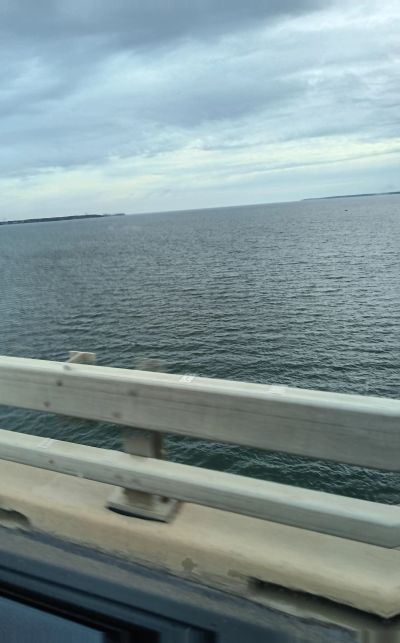
Chesapeake Bay from Bay Bridge Tunnel; photograph by Gail Swanson
10. Wendy Howe
Two Poems
Capistrano
After two sleepless nights, I dreamt
of a Spanish mission and Capistrano took me in.
Around the walls of a roofless tower,
I walked and saw bells framed in stone casements
waiting for a ringer to launch them in song.
White flowers dodged the wind as they hunched
in the shadows; and my skin shivered too.
I wanted to hear the peal of tongues,
the hour tolling an answer to my prayer.
But only glare stared back like a woman veiled
in yards of bleached light. You were too far away
to be touched, to let your voice disturb the bells
resonating some reference to love; or your breath
to stir the swallows that nested here, their flight
spinning a black capuchin, a hood of grief
that would lift and slip beyond the skyline
as Autumn tindered her time of fire, scattering ashes
of what came between us. But you were too far away
standing in a garden of cactus and flagstones.
The sun was much warmer there
but I feared your heart had grown rugged
as driftwood sculpting the desert landscape.
God was still trying to reach you,
a cloud seen in the blue distance, an umbel
of blossoms shedding empathy
as my flesh longed to be kissed, stroked with mercy --
sensing our reunion belonged to Him, not us.
Poet’s Notes: “Capistrano” was written after a dream about trying to reconcile with my husband during an intense separation. I was searching for answers and spiritual guidance to handle the future. This poem explores how I found refuge among the ruins of a historic mission. Features of its landscape including the white flowers, the swallows, the stone casements and the Autumn season were external details that underscored my inner turmoil. I wanted immediate peace and reassurance that my marriage would survive.
Yet, through physical and mental wandering, I realized my partner was in a distant place and might remain impossible to reach. I was looking for my life's solution with a narrowed focus and desperate attempt to make things happen. I felt powerless yet wanted full control of the situation. Through prayer and perceiving that cloud in the distance, I knew God was listening. He made me realize I needed to trust His judgment and surrender myself to His divine compassion and will.
****
After The Virus Came
The earth has stilled
as one day blends into the next.
And for us, the wind holds its breath
as we walk the field hearing
a sparrow sing in the pines. Her song echoing through us
like an aftershock of grief.
A steep hill looms on the horizon
along with a tower. And today it's not so much
a cell phone tower but a cross --
radial, reminiscent of the one
they carried through the streets of Rome
in 1522.
And among the crowds assembled, for 16 days,
there may have been a couple like us, their breath shielded
by cloth or a sponge soaked in vinegar,
their skin sore from the cleansing
of house and hands. An all day ritual done
between prayers and meals, gathering and sorting herbs;
clove, camphor, juniper and other amuletic plants.
Yet, they went out risking illness and loving each other more
as the crucifix rose before them, receiving fear
and transmitting hope. The voice of God silent
but felt in the sun palpitating
through the cypress trees, the sudden lift of birds
from the stone eaves of a church -- and their hearts, our hearts
tremulous with the flicker of faith, its bond to eternity.
Poet’s Notes: After Covid came, we were in a California lockdown. Walking outside, our yard provided relief and personal freedom. I became more aware of a sparrow's song, the pines' scent -- even the shape of clouds. I kept thinking how we and our environment were threatened by the shadow of disease. Yet, when I noticed that cell phone tower on the hill, something within me transcended fear. It became symbolic of a crucifix serving as a landmark, a sacred relic offering mental and spiritual comfort. I had read about the plague of 1522 where a procession carrying the cross from The Church of San Marcello al Corso to Saint Peter's Basilica in Rome lasted for 16 days. The event was an act of defiance against the plague and a renewal of faith. People emerged from isolation and risked their health to watch and participate in this holy process. Somehow, I felt closer to my husband and those who suffered historically and survived. The pandemic made me question the worth of my life, its fragility and potential for loss. Yet in looking for reasons why and ways to cope, I found peace. Not absolute promises or guarantees but a spiritual resurrection of my trust and belief in God's vigilance.
About the Poet: Wendy Howe is an English teacher who lives in California. Her poetry reflects her interest in myth, women in conflict and history. Application of imagery, personal reflection and rhythmic language are basic elements of her writing style and expression. Over the years, she has been published in a variety of journals. Among them: The Poetry Salzburg Review, The Interpreter's House, Indelible Magazine, The Orchards Journal, Songs of Eretz, Sun Dial Magazine, The Linnet's Wings and many others.
Lower Methodist Church, Middlesex County, VA. Photograph by Gail Swanson
Butterfly Sculpture, Hosta, Azaleas, Photograph by CAS
11. Two Poems by Benjamin Chitambira
The Desert in Him
The mirage of his life,
was strewn on the highway -
trodden by the wheels of time;
scattered like sand grains.
Left behind.
The desert in him,
like a place where many beautiful flowers
could have blossomed but have not,
looked like unfinished strokes of paint
on the wide golden canvas.
For something tender – to touch,
all he saw were thorns
on thick ugly green plants,
For the scent of flowers, dust
stung his nostrils
Until he saw the oasis,
soothed the parch in his throat,
dug underground and found his salvation
saw birds collect nectar from the cacti and
drank the sustenance of life
*****
Butterfly
You float,
a coloured but brief life,
among beautiful flowers
you forage.
From one beauty to another,
sweetness of the eyes -
sweetness of the tongue
you search.
Yet without you, no more beauty
for the next season would come.
your delicate hairs and wings
never just for our eyes to savour,
cross-pollinate,
sustaining nature’s beauty
as you transform from egg
to caterpillar,
then pause your brief life to live -
cocooned, to emerge prettier
Only your creator knew
there is nothing brief.
Every stage of your brief
sustains life –
seeds for the next generation
food for other created beings
your beauty and life
never in vanity - vainly fluttering
About the Poet
Benjamin Chitambira is retired after 28 years of physiotherapy practice. The later half of his career was dedicated on research for new ways of reversing paralysis early after stroke, traumatic brain injuries and prolonged intensive care stay paralysis. He has always practiced creative writing in his spare time. One of his poems was published after being selected in a national poetry competition.
12. Vivian Finley Nida
Epiphany
I sat in my assigned seat and asked,
“May I sit by the window, please?”
No other first grader spoke.
The teacher ignored me,
handed out papers and said,
“Color this baby chick.
Stay inside the lines.”
Grandma had baby chicks.
One was brown, so with a brown crayon,
I colored inside the lines.
Next day, a border of baby chicks
circled the classroom, but I couldn’t find mine.
I asked the teacher about it.
“I didn’t put it up. It didn’t match the others—yellow.”
My chicken was not returned, evidently discarded.
I understood.
A generation later, my daughter,
at a Blue Bird meeting, happily accepted
wooden Christmas ornaments to paint.
I was a helper that day, and saw
her hold an angel in one hand,
a brush dipped in black in the other.
“Are you sure?” I began, but stopped.
The leader touched my shoulder, said,
“It doesn’t matter.”
Poet’s Notes: When “Looking for My Life,” I found that experiences more than items influenced me. This poem includes two of those.
About the Poet: Vivian Finley Nida is a retired English and Creative Writing teacher, a Teacher/Consultant with the Oklahoma Writing Project, and a member of the advisory committee for Oklahoma City University’s Thatcher Hoffman Smith Poetry Series, which brings an award winning poet to campus each year. Her poetry appears in Oklahoma Humanities magazine and other fine publications. The title of her book of poetry, From Circus Town USA, published by Village Books Press, comes from the nickname of her hometown, Hugo, Oklahoma, which serves as winter headquarters for several circuses and is home to the Endangered Ark Foundation, a non-profit dedicated to the preservation of Asian elephants. She and her husband live in Oklahoma City, Oklahoma.
Baby Chick Photograph by Charles Crawley
13 Howard F. Stein
Two Poems
In Search of Life
With giant telescopes and deep space probes,
We scan far galaxies for signs of life –
No doubt a worthy venture, especially if
We have secretly written off the earth as doomed.
I find life in towering sequoias,
In bluestem flowers and tiny buttercup;
In hearty bristlecone pine and scruffy oak,
In crusty lichens on wintered bark;
I find life in an old folks’ home nurse’s aide,
Who hugs her lonely patient after giving bedtime pills;
In a schoolteacher who does not give up
On a student of scorned skin color or accent.
I do not impugn doctors’ vital signs – heart rate,
Blood pressure, and oxygen level;
But I send my own probes way deep inside,
To tell me whether I am really alive.
Poet’s Notes: When I first learned the theme for this issue, “Looking for (My) Life,” the seeds of two possible poems almost immediately began to germinate, this one, and “Sameday,” also included in this issue. My search for life in this poem contrasted with that of missile-launched satellites and deep space probes, beginning in the 1950’s, and culminating in the James Webb Space Telescope that has ventured billions of miles from earth. For me, nearly from the outset of the “space age,” the technological venture interwove genuine scientific curiosity with a growing dread that, as we humans destroy the earth, it might be uninhabitable. With it came the often-magical obsession with finding planetary systems elsewhere in the universe – maybe some of which might become our future home after we have spoiled ours.
This poem searched here on earth for signs of life – and not mere biological presence, but aliveness, vitality. I began with my tenaciously beloved Nature, and ended by sending spiritual as well as biological probes into my (and our) inner spaces, including the human unconscious in all its dimensions. I had, and continue to have, an urgency to know whether aliveness dwells within – or whether I merely exist, counting the ticks on my biological clock. For the sake of my very life, I need(ed) to know.
*****
Sameday
Seven days of the week, at least
As enumerated in English:
Sunday, Monday, Tuesday, Wednesday,
Thursday, Friday, Saturday –
Some days even called
By their significance:
“Another Monday,” known for expectation
Of the usual tedium of return to work
After a supposedly relaxing week-end;
“Hump Day,” Wednesday, mid-point
On the steep climb of toil, then
“Downhill from there,” toward weekend
Recovery and restoration, a yearning
All summed up in TGIF – “Thank goodness it’s Friday,”
Gratitude for fulfilment of hope
And anticipation, release,
Relief from the workaday world;
Regeneration and preparation for
The next cycle of unwelcome work.
In old folks’ homes and nursing homes,
Nomenclature is more felt than said:
The senses confer what lips
May not be able or allowed to utter.
All seven are Samedays, despite crowded
Monthly schedules of diverse activities:
Bingo, exercise, movies, balloon volleyball,
Dominos, worship, puzzles, occasional outside performers,
The weekly cycle of meals, seasonal and holiday
Decorations and celebrations – busy, though
As routine as a metronome.
Everyone and everything part
Of the wheels and gears
Of a ticking clock.
Ouroboros, that mythical snake
Who coils and bites its tail,
Depicts the renewal of yet
Another cycle of endless repetition –
Ouroboros knows Sameday well,
Is condemned to a life
Of eternal monotony.
Anywhere could be anywhere else;
Anytime could be any other time.
For people who are able,
An occasional outing to a supermarket
Or shopping center, offers a brief
Burst of sunshine in the overcast
Atmosphere of Sameday and Sameplace.
Otherwise, except for occasional
Power outages from storms,
And water pipe bursts,
Mostly television offers evidence that
A world beyond Sameday exists.
“Sundown syndrome,” a leaden clinical term
For confusion and fear set off by light deprivation,
Often at the end of the day, hardly
Begins to paint the vast canvas
Of the many shades of darkness and shadow
That haunt Sameday. Daylight or nighttime,
Fluorescent or incandescent,
Make little difference to
The oppressive deprivation
Of eye and spirit
That Samedays incur.
Poet’s Notes: This poem is the offspring of my urgent, even desperate, search for a sense of aliveness as I dwell – now for 3 ½ years – in a medical residential facility called “assisted living.” Millions of mostly elderly people reside in various institutions of assisted living, nursing homes, skilled nursing homes, and others, that are well known for their attempt at mechanical assembly line efficiency and which in the process become soul-deadening to their residents or patients.
In this poem, I try to bear witness to and evoke the lived experience of pervasive ritualized routines, subtly and strictly enforced sameness. A social, medical steamroller crushes curiosity, individuality, creativity, even a glimmer of vibrant aliveness even in the midst of decline and sickness. If the inhabitants of these old folks’ home facilities are far from the condition of barely walking-dead Muselmann of Nazi concentration camps, resigned to their fates, they (we) are nonetheless zombified, hollowed-out vessels of the emotionally alive humans they still could be – with all their limitations and conditions. We are no longer a who, but only a what – object.
Even the flurry of organized social activities and meals in these facilities rests on cycles of repetition, sameness, which gradually wear down personal distinctiveness. The great sociologist Erving Goffman called facilities such as these “total institutions,” and psychiatrist Murray Bowen described the process of “de-selfing” in pathological families.
The title of my poem emerges from this soul-killing uniformity. I called it by a neologism (I think), “Sameday,” that is, the erasure of differently named days of the week, each with a distinct identity, and their replacement with the same name for each day of the week, indistinguishable from the other. Many fellow residents where I live call their apartments “boxes” or “cells.” Likewise, many residents have said to me in a resigned tone that that are here “putting in time, waiting to die.”
This is not the atmosphere portrayed in the glossy brochures, videos, and tours of prospective residents and their families. But the erosion of distinctiveness to sameness and deadness is relentless and unforgiving. My poem attempts to portray this world.
About the Poet: Howard F. Stein is an applied, psychoanalytic, medical, and organizational anthropologist; psychohistorian; organizational consultant; and poet. He taught for nearly 35 years in the Department of Family and Preventive Medicine, University of Oklahoma Health Sciences Center, Oklahoma City, OK, US. He is author, co-author, or editor of 35 books, 11 of which are books or chapbooks of poetry. His most recent poetry book is Standing in the Chaos (2024). He has published over 300 poems. He was Frequent Contributor to Songs of Eretz Poetry Review. He is Poet Laureate of the High Plains Society for Applied Anthropology, and Psychohistory Poet Laureate. He can be reached at hfs.dad@gmail.com
Metronome; Photograph by Charles a. Swanson
Falling Springs Fall, Alleghany Co., VA., by Gail Swanson
14 Wilderness Sarchild ~~ Poem
Directions
You must wait until the swirling winds
are dancing with the phragmite reeds
on a night that is bright with a blue moon.
Only then may you set out walking, following
in the footsteps of 10,000 pilgrims
who, before you, also heard the cry
of the great horned owl and knew that
this was an invitation to journey
beyond the place where you once saw
a deer nursing her young, and a snake
gazing down from the highest tree branch.
You’ll know you’re getting close
when you forget to care
about time or distance or intention.
This is when a kaleidoscope
of butterflies will dress you
in their wings and hold up a mirror
that dreams you into the pages
of a book like the one
you gave your daughter
when she was five
except this book is as tall
as the ancient redwood
that lived in your back yard
and hid you from the town bullies.
Every page that you turn
will come to life:
your own birthing scream
as your exhausted mother felt you
for fingers and toes;
your first kiss with your friend
who pretended to be Elvis;
driving away with your children,
from a marriage broken by bruises;
finding God in a deserted canyon,
in a sleeping lion in the savannah,
in a man with hands like silk
and a heart that sings.
Turn the pages of your past
until a new sun rises and you
come to the blank pages
of your future. Begin with
a word or a song or silence.
Go slow, be brave, breathe.
About the Poet
Wilderness Sarchild is a poet, playwright, psychotherapist, certified facilitator of therapeutic psychedelic journeys, lay UU worship associate, and a grandmother of six awesome young people. She is the author of a poetry collection, Old Women Talking, and the co-author of the play, Wrinkles The Musical. Wilderness is currently working on a new poetry manuscript with the working title, Practice Dying.
Wilderness writes poetry as a way to make sense of a world that is determined to break our hearts, and in her desire to find the sacred in everyday life.
15 John C. Mannone
Two Poems
Seeking Solace
After Barbara Ras
You can’t have it all, but you can have a flower
whose petals burst like the sun cupped in your hands.
You can have the spring breeze caress your face
while waking in the morning, a song of the joyous sun
lifting itself over the mountains. You can have the hum
of the honeybee working for nectar in the field—
the field of your dreams, where disappointments
only flourish for a little while before the sky cries
to wash them away, then gives you a rainbow
that you can carry in your breast pocket. You can
have books that’ll take you to interesting places—
to grand cities or to the luscious countryside and woods
or to the quiet stars. In the silence of solitude
you can hear the creak of the floorboards in your bedroom
as the ghosts of memory gather by your side and taunt
you to stay.
Rocketships blast the silence,
but you can’t count on the sound
of wishes to rescue you. You can close your eyes and dream
or dream wide-awake where you’re holding hands—
yourself tugging you to follow the shooting star.
You can see the glints of stars flicker like fireflies
on a June twilight in the forest. You can have that pine
scent, an incense, a gift from trees bruised in a hailstorm,
a balm for worry. You can learn the language of trees
as they bleed for you, because they are the descendants
of the Cedar of Lebanon that once stood in the middle
of the garden. You can have joy (despite unhappiness),
for it comes in the after-mourning, no matter how long
the night, with the sun nowhere in sight, and the moon,
draped in darkness. You can have the light in a Carolina
wren’s song that can melt the snow of lingering burdens.
You can give love. And you can have love. But don’t ask
the stars what it is. What you crave for, look in the closet
of your mind, rummage through each box and garment
of promises. Find the one with you in it as a child.
Examine the cardboard walls, the deck of cards stacked
and propped up to make a fortress where you once hid,
surrounded by green plastic Army men with tanks and
guns— they never questioned your dreams.
Remember? You can ask them anything and they
will teach you how to fight, again. Fight in the ring
drawn in the dirt with your cat’s eye marbles
scattering the opposition’s into your pocket. Run.
Run like your life depends on it, just as you did
from Baltimore bullies. Escape the sticks & stones,
the chains & knives. Jump fences (even in loafers).
Depression is a much larger threat. It’s okay to cry,
but don’t
drown in the tears. You can bathe
in the sweet, red-letter words— they are blood
promises. You can’t have it all, but Jagger said
something about trying, and sometimes you
can get what you need. But better yet, listen
to the other man whose name begins with J,
who looks out for the bluejays and sparrows,
as well as you, and me. You can hear the glass
clinking, the champagne echoes, the whisper
of peace.
Poet's Notes: A recurrent thing for me is the quest for peace. Funny thing, it's there all along, I simply have to "stop and smell the roses."
*****
Black & White
Journal entry, May 30, 1979
Wind River Wilderness, Wyoming
The landscape is vivid Kodachrome and it is warm this Memorial Day weekend. I start to hike up the backcountry to camp in the mountains: nylon straps tension against my shoulders, legs torque hips; my hiking staff stabs the ground for balance in movement. I bulldog up the mountain to the flower-whitened knoll. Its soft grass sways in the Wind River wind that whispers words to me. I feel the solace of this place, the pine-scented truth, ethereal yet tangible, if only for a moment. I am with friends, but I am alone.
Where are you?
It snowed five inches overnight. I trudge downhill a few hundred feet down to the black river, my thoughts still heavy. Water plunges into cascades smoothing granite that was once hard gray, but now is slick—its atoms dissolving. Pine trees sentinel the glacier-scoured valley that was hollowed-out millions of years ago. How did the valley learn to grab the night cold and wrap itself in the morning with white? Yesterday’s dirt is tucked under the snow quilt. My dome tent, like an igloo, stands stark against the black and white water; ice blades jab the riverbank.
How many times has this drama played-out? How many times have I heard the wind rush its hushing words into my ears? Into my heart? Everything I hear is true:
Even the sparrow has found a home
and the swallow, a nest for herself…
Don’t be afraid; you are worth more
than many sparrows. 1
The black-capped chickadees, dressed in white, scamper the rimed glaze and peck the ice, picking conifer seeds there dropped as manna. They leave imprints, a wedged mosaic of frozen dance steps. I listen to their music, imagine their secrets about love.
I lie down next to them. Stay still. Perhaps they’ll think I’m some kind of bird-god in blue—goose down shell, pileated toboggan; my sweater-arms fold as if they’re red wings. But I am the one who is praying for answers to the cold-chiseled questions glyphed here on a blackboard of snow.
Across the river, an elk bugles for his mate, his cries echo off the rocks, wind-worn; the cliff-face stares at the brutal loneliness—its silence is hushed by a solitary sagebrush.
__________________________________________________________________
1 A conflation of Psalm 84:3 and Luke 12:7
Poet's Notes: When I wrote this piece, I didn't know the Lord, other than his historicity, so I turned to nature to answer my questions, especially about love (in the context of a failed marriage). Love gives meaning to life, to my life.
About the Poet: John C. Mannone’s work appears in Artemis, Critical Humanities, Appalachia Bare, Red Branch Review, Poetry South, and others. Awarded the Jean Ritchie Fellowship (2017) in Appalachian literature, he authored five full-length collections (and six chapbooks), including the Weatherford Award-nominated Song of the Mountains (Middle Creek Publishing, 2023); and a top-eight finalist for the 2025 Tennessee Book Award, Sacred Flute (Iris Press, 2024). He’s a retired professor of physics and the Poet Laureate for the City of Oak Ridge (2026-2028) in Tennessee.
Dogwood in Bloom; Photograph by Charles A. Swanson
16 Arvilla Fee
When the World Presses
social media
news channels
radio stations
voices voices voices
to whom do we listen?
whom do we believe?
both sides are clamoring to be heard
both sides claiming to hold truth
shall we be torn in two?
where is Solomon in all his wisdom?
the quest to stay informed
overwhelms our senses
the light seems to grow smaller
and smaller
have we forgotten
how this story ends?
have we forgotten
the One who gave us life?
let us lift up our voices
not in anger
not in dissent
but in praise for the One
who conquered
death
hell
the grave
and gave us victory
About the Poet: Arvilla Fee lives in Dayton, Ohio, with her husband, three of her six children, and two dogs. She teaches for Clark State College, is the lead poetry editor for October Hill Magazine, and has been published in over 130 magazines. Her three poetry books, The Human Side, This is Life, and Mosaic: A Million Little Pieces are available on Amazon. Her newest book, The Stars Above Us will be released by Kelsay Books in May. Arvilla’s life advice: Never travel without snacks. Visit her website and her online magazine: https://soulpoetry7.com/

Inside My Eye; Photograph Captured at Ophthalmologist's Office; Photograph by Charles A. Swanson

Sugar Maples with Collecting Buckets, Photo, Gail Swanson
17 Sharon Waters ~~ Two Poems
In Here
I lift my eyes to the far-flung hills
where bears lie in wallows and anthills bulge.
I wish I could climb over this window sill
and escape to the woods where old bucks lunge
across chilly streams while eagles eye their prey.
I’d like to join life where cells divide -
where soil holds rotting matter which has lain
in wait for wind-thrown seeds to fall and abide,
plunge deep for mineral and water-infused life.
I want to roam where I’m not needed -
contributing to what brings joy instead of strife.
Where everything halfway in will be ceded
until it fights for better, or accepts its death.
*****
Easter Arrives
Resurrection sneaks in like a raccoon after cat food
while we are still loading firewood, making chili,
and concerning ourselves with dogwood winter.
New life seems to be like that. It slides into place
while we busy ourselves with other plans. When we
stop and turn around, change has come.
Jesus said it would be this way—that only those
paying attention and seeking to find the glorious
would see it when glory shuffles in humbly on a donkey.
About the Poet
Sharon Waters is a retired pastor, writer, and musician who holds an MFA in Creative Writing from West Virginia Wesleyan College. She has published work in 30 Short Plays for Passionate Actors, Women Speaks-Volume X, and Kakalak 2024, 2025. Waters has also been published in Longridge Review, MicroLit Almanac, Pine Mountain Sand and Gravel, and Painted Pebble Lit Mag. She has also won or placed in several poetry and prose contests in Tennessee, Virginia, and West Virginia. Waters currently lives with her husband and a clowder of cats in Beckley, WV.
18 Linda Vigen Phillips
When the Muse Allows
writing poetry is warm sand sifting between toes
every grain a brain tickle
it’s afternoon wind coming in from the lake
bundled in scent of ponderosa pine
it’s cumulus clouds moving in time-lapse
view of a sky-blue day
writing poetry is the rounded edge of a raindrop
resting on a blade of grass
it’s the nestling bluebird’s head peeking out the
entry hole at the fledging moment
it’s Pachelbel cradled in swells
of Pacific breakers and roaring wind
it’s the infant’s grasp of a weathered finger
the lanolin touch that heals
it’s a fresh-cut bouquet of words
Poet’s Notes: Writing poetry can be absolutely frustrating as well as absolutely exhilarating. In my life it has been therapeutic and cathartic, the place where I have gone to deal with the persons, places and things that don’t make sense. It has also been the way I have celebrated many of the high points along the way. Writing poetry and reading the poetry of others is where I continue to find life-giving energy, support, sustenance.
About the Poet: Linda Vigen Phillips is an award-winning author of two Young Adult verse novels, Crazy and Behind These Hands, and an adult poetry chapbook, Thoughts at Crossings. Her poems have appeared most recently in this literary journal, Please See Me, Consilience, The Christian Century, The Clayjar, and Last Leaves. She and her husband live in Savannah, GA.
Vase of Flowers, Oil Pastel, Melanie Faith