Joy Issue: Fall 2026
How great to bring you poems from many voices
Photograph on the right by Lucinda S. Austin
See the below for Lucinda S. Austin's biographical sketch.

Poems with Joy in the Title

Photo on the left: Coffee in S. Africa by Lucinda S. Austin
Kenneth Pobo
"This Little Joy Poem"
John C. Mannone
"Joy to the World: A Christmas Psalm"
Vivian Finley Nida
"Finding Joy"
Sharon J Clark
"Carpenter or poet: the joy of creation"
Doris Ferleger
"Joy's Blush"
Howard F. Stein
"Joy Is . . . "
"Tincture of Joy"
Sacred Poems
Photograph on the Left, Stained Glass Window, Melville Avenue Baptist
Wilda Morris
"Alabaster"
John Davis
"Good Friday"
Mantz Yorke
"Sacré-Coeur"
Peggy Heitmann
"Visions"
Mike Wahl
"For Keeping Me Intact"
Teresa Lockhart Eisenlohr
"Worship"
"Sometimes"
Wendy Howe
"The Bouquet"
Patricia Hope
"Another November"
Tyson West
"Triangulation"
Lucinda S. Austin
Biographical Sketch
Poems of Celebration
Photograph on left by Tracey Thiessen
See below for a biographical sketch of the artist
Lucia Coppola
The Fox and the Dog"
Llewellyn McKernan
"The Storm"
Robert (Bob) Findysz
"A Balkan Magic Carpet Journey"
John Delaney
"Not to Get Too Sentimental"
"At Least"
Brendan Dawson
"A Garden Opera Aria"
Mantz Yorke
"Vulcan"
Satish Pendharkar
"On Hearing You Cry"
James B. Nicola
"Sometimes I Meet"
A Miscellany of Joy
Photo on Left, Spears & Shields, S. Africa, by Lucinda S. Austin
John C. Mannone
"Happiness is a bird"
Ceili McCollonough
"Do"
Mike Wahl
"Stones to Dirt"
Laura Gunnells Miller
"Columbine at Big Soddy Trailhead"
Todd Matson
"Dodging a Bullet at an ATM, With a Little Help from Friends"
Wendy Howe
"Coming Home"
Mari Fitz-Wynn
"Raindrop Romp"
Tyson West
"Quitting Time"
Colette Tennant
"Hallelujah"
"Mid-September and Dragon Begonias"
Charles A. Swanson
"Glory of Glories"
Devotionals
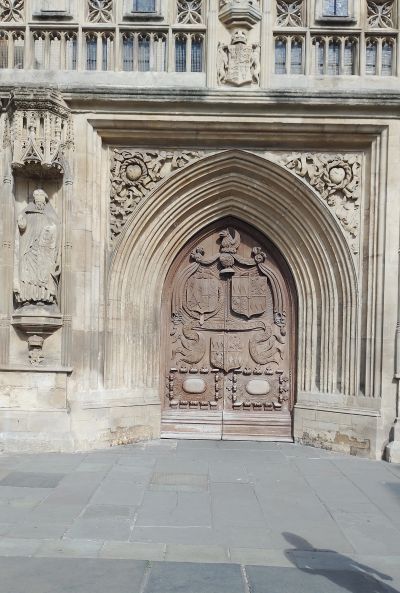
Bath Abbey, England, Photo by Gail H. Swanson
John C. Mannone
"Devotional on Joy and Happiness"
Charles A. Swanson
"Jesu, Joy of Man's Desiring"

Sun and Clouds, Atlantic Ocean, Photo by Lucinda S. Austin
Poems with Joy in the Title
Kenneth Pobo
This Little Joy Poem
During last night‘s storm,
rain sounded like someone
throwing marbles
at our windows. This morning,
sun. I visit the garden
and see that the mango tango
marigolds now have four blossoms,
many more coming. If this
were night, they’d be
lit candles.
Poet’s Notes: Our garden offers many reasons/opportunities for joy.
About the Poet: Kenneth Pobo (he/him) has a new book out called Raylene and Skip (Wolfson Press). Also recent is Lavender Stones (Rockwood Press). His work appears in Meetinghouse, North Dakota Quarterly, Crannog, and elsewhere.
*******************
John C. Mannone
Joy to the World: A Christmas Psalm
After Isaac Watts and Johannes Frederick Handel
The angel, Gabriel, makes the announcement
and a multitude of seraphim and cherubim join
in praise with all of creation: Glory to God
in the highest heaven; and on earth, Peace;
good will toward men. For unto us today
a child is born, his name is Emmanuel, who
is God himself with us all, who is Wonderful,
Counselor, Mighty God, Everlasting Father,
Prince of Peace— the entire Holy Trinity.
Joy to the world! The Lord is come:
Let earth receive her King.
This is the day the LORD has made,
rejoice and be glad, sing the praise,
sing unto the Lord with the harp
and voice of psalms; with trumpets
and cornet, make a joyful noise.
Joy to the earth! The Savior reigns:
Let all their songs employ.
Let the sea roar as waves slap
the shore; let the mountains break
into shouts of joy, and all the trees clap
their branches before the Lord,
for now he comes to save the world
every corner of the map.
and later, he’ll come again to judge.
No more let sin and sorrow grow
nor thorns infest the ground.
The bramble and nettle will not rise up,
but myrtle and cypress will; and high
the evergreen, the everlasting
will be memorials to the LORD—
an everlasting sign that’ll never die.
Poet’s Notes: An allusive collage, the poem has a high density of references to the lyrics of “Joy to the World” (which is based on parts of Psalm 98 by Isaac Watts) and also to references in the Scriptures, such as Psalm 98, Psalm 118:24, Isaiah 55:11-13, Luke 2:13, Isaiah 9:6, and Isaiah 7:14.
Though a free verse poem, this poem, after the introductory verse, exhibits loose connections to the Trimeric form (https://www.writersdigest.com/write-better-poetry/trimeric-poetic-form), while also adding selected end rhymes (abcdb, abacdae, abcdb).
At the time of publication, though apparently months away from Christmas, it can be argued that the Christ was born in the Fall rendering this poem as timelier (see the article: Mannone, John C., “Commercialization of Christmas,” GoodNews Christian Magazine, October 2016, page 46: https://issuu.com/goodnewscm/docs/cleveland_october_2016). Finally, the history of this hymn can be found here: https://www.umcdiscipleship.org/resources/history-of-hymns-joy-to-the-world-1
About the Poet: John C. Mannone's work appears in Appalachian Journal, Artemis, Critical Humanities, Appalachia Bare, Red Branch Review, Poetry South, The Windhover, and others. Awarded the Jean Ritchie Fellowship (2017) in Appalachian literature, he authored six full-length collections (and six chapbooks), including the Weatherford Award-nominated Song of the Mountains (Middle Creek Publishing, 2023); and a top-eight finalist for the 2025 Tennessee Book Award, Sacred Flute (Iris Press, 2024). He's a retired professor of physics and the Poet Laureate for the City of Oak Ridge (2026-2028) in Tennessee.
********************
Vivian Finley Nida
Finding Joy
Years ago, walking on a sandy shore,
Mama found a conch shell,
the length of her hand.
When she held the treasure to my ear,
ocean’s murmur made me smile.
I swayed side to side, thinking of gentle waves.
She wrapped the shell in a soft handkerchief
and kept it safe in a dresser drawer.
Now, it rests on my coffee table.
Hands of all sizes can reach it,
lift it to an ear, and listen.
The sound puzzles some.
They peer inside, searching for the source,
but when others listen to the shell
and hear the resounding whoosh,
they imagine surf, sand, jellyfish, sharks
and mesmerize listeners with tales that crest
like highest waves, lift spirits, inspire delight.
Poet’s Note: This shell, a gift from nature, has brought much joy to people of all ages since Mother found it in the mid 1940’s.
About the Poet: Vivian Finley Nida is a retired English and Creative Writing teacher, a Teacher/Consultant with the Oklahoma Writing Project, and a member of the advisory committee for Oklahoma City University’s Thatcher Hoffman Smith Poetry Series, which brings an award winning poet to campus each year. Her poetry appears in Oklahoma Humanities magazine and other fine publications. The title of her book of poetry, From Circus Town USA, published by Village Books Press, comes from the nickname of her hometown, Hugo, Oklahoma, which serves as winter headquarters for several circuses and is home to the Endangered Ark Foundation, a non-profit dedicated to the preservation of Asian elephants. She and her husband live in Oklahoma City, Oklahoma.
********************
Sharon J Clark
Carpenter or poet: the joy of creation
If my dad had been a poet instead of a carpenter
he’d have crafted lines of smooth creamy words
no rough knots or thorns to piece the skin
leaving splinters buried in flesh
no awkward juxtapositions of phrases or terms
just the perfection of flawless dove-tailed couplets.
As a poet, he’d have caught the beauty of ash and pine
in stanzas of rhyme and rhythm, as green and fresh
as unseasoned timber, full of promise and secrets.
He’d have made his words gleam with the tender patience
of a master French polisher, causing them to drink deep of
the richness of beeswax nourishment.
At the end of each working day, he would
set his poems before the world.
Some resonating with the practicality and wisdom
of bookshelves and comfortable chairs.
Others saturated with the soul-piercing joy
of a father’s love
carved into driftwood sculptures
bleached white by the sea.
Poet’s Notes: My father was a carpenter and some of my happiest childhood memories were spent in his workshop. I drew from that experience when writing this poem.
About the Poet: Sharon J Clark is a poet and short story writer living in Milton Keynes, England. Her writing has been published in a number of anthologies and online literary magazines, including Still Point Arts Quarterly and Blink Ink. She has published two poetry collections and a collection of mystical short stories. She also publishes a weekly Substack newsletter about life, books and poetry called Looking to the Horizon.
*******************
Doris Ferleger
Joy’s Blush
I threaten
to suck
my love’s
earlobe
in the theater
we are old
he, head shaved
except one skinny
silver strip
he can’t see
or reach
just the thought
of my tongue
blushes him
I so love
to make him
blush
is it wrong
to call us
blessed?
About the Poet: Doris Ferleger, MFA, Ph.D., poet laureate emeritus of Montgomery County, PA, and winner of the New Millennium Poetry Prize, New Letters Poetry, Songs of Eretz Prize, and the AROHO CNF Prize, among others, is the author of five full-length books, including Big Silences in a Year of Rain, As the Moon Has Breath, Leavened, As for the Kiss, and To Claim Loneliness, and a chapbook entitled When You Become Snow. Her work has been published in numerous journals including Cortland Review, Delmarva Review, and Poet Lore. Aliki Barnestone writes of Ferleger’s award winning work: “Ferleger’s memorable poems keep singing with their insistent beauty.”
********************
Howard F. Stein
Joy Is . . .
My greatest joy is
In the least expected –
A meteor streak
Across a familiar sky;
A dandelion – not a daffodil –
My spring’s welcome herald;
An exception to old rules,
That opens a window
To a house of stale air.
Joy is Pentecost,
When the concealed is revealed,
And life, never again the same.
Poet’s Notes: When I learned that the issue theme for Flowers of the Field, Fall 2026, is joy, one of my first thoughts was the question, “What is joy?” I immediately thought of the final movement of Beethoven’s Ninth Symphony, for vocal soloists, chorus, and orchestra, the stirring setting of Friedrich Schiller’s “Ode to Joy.” My mind drifted to other obvious, and equally large-scale, examples of evocations of joy.
As my mind drifted even further, I found myself thinking of unexpected moments and experiences of joy. I had found my subject – or it had found me. The resulting brief “definitional” poem would be built around surprise and wonder. Joy enters when some ordinary event suddenly becomes extraordinary. Some alchemic transmutation transforms the familiar into surprise – and with it, delight.
It feels like a miracle in Walt Whitman’s sense. I hear “the same” piece of classical music I have known my entire life; then this interpretation sweeps me off my feet, as if (so goes the cliché) I am hearing it for the first time. So refreshing, so welcome.
Then there is the perhaps-seeming bizarre final stanza about Pentecost, the Descent of the Holy Spirit, the Presence of G-d in our midst. Here was an “ordinary” group of people, the Apostles of Jesus. Suddenly arrived the Presence of what Dietrich Bonhöffer called “the Beyond in the midst.” What joy, as Transcendence becomes Immanence.
The “arrival” of the final stanza added a time-out-of-time dimension that took the little poem to places and moments beyond my comprehension – just as does a profound interpretation of Schiller’s “Ode to Joy” in the fourth movement of Beethoven’s Ninth Symphony.
**
Howard F. Stein
Tincture of Joy
A swelling gibbous moon
Rises high in the southeast
As the sun edges
Toward the western horizon.
I feast my eyes
On its gleaming silver.
Soon, it will have
A whole prairie
Sky to graze on.
Macular degeneration has
Consumed my retinas so
Only the fovea, that
Blessed central tunnel
To light, remains.
In the restaurant parking lot,
I linger with my moon –
Until I must get
Into my son’s car, so
He can return me to the
Old folks’ home where
I now live. An occasional
Outing to a familiar eating place,
Or to a small local lake, where
I once spent hours in the wilds,
Feels like a prison leave
For good behavior. But there
Is no release for this elder-sentence.
Too short-lived, this
Reunion with my moon,
For which I must trade
Sky for memory – as
Long halls and Kitsch-art walls,
Tiny rooms and soul-stifling
Routines overtake immersion
In a moment’s joyful bliss,
As I now must place
My sky and its moon
In the pocket of memory,
Until the next – if next – venture
Beyond these red brick walls
Offers me a reprieve from
Ever-so-well-intended
Confinement by my family solely
For my own protective good
(and, though never spoken, their
Release from me for lives of their own).
Still, they cannot rob me of my joy
Of those intimate moments
With this ascending moon
Near sundown. Mine, all mine!
No thief can steal what once was –
When, for nearly eight decades,
Our worlds coincided,
I could feast my hungry eyes
On the monthly circuit of the moon –
Now, I must measure my joys
In small doses, taste sweet
Memories in morsels.
Still, memory of joy is still joy.
Poet’s Notes: This poem is about the sense and feeling of joy that exist in tiny portions. This poem arose from the often-unbearable tension between a seemingly unlimited, expansive universe I inhabited before my family “placed” me in an assisted living facility (medicalized old folks’ home) nearly four years ago, and my diminished world afterwards. I was given notice only three or four days before I was to be relocated. Certainly, my neurological “conditions” made my gait precarious, balance difficult, and falls frequent. Still, “outsourcing” me was at least as much pretext for riddance as it was for concern for my health. How could a moon compete with this?
With no time for me to prepare (emotionally as well as practically) and to plan ahead for the move, with its vast change, I felt a devastating sense of rupture, of being ripped from an entire sense of place and belonging in the world. I refer here not only to a house and tree-filled yard, but also to the woodlands and embedded homes that characterize the entire neighborhood – and the moon above, with its comforting rhythm.
For over 75 years, I had measured much of my life by my connection with the cycle of the moon. It was a source of great joy. In my family’s placing me in the large medical residential facility, located on the margin of the city, I was not merely dis-oriented. I lost my-self. Neither my family nor my new health caregivers seemed to notice or to care.
My world suddenly shrank and became severely confining, as much by medical rituals and repetitious daily routines as by tiny living space (my apartment, 400 square feet) and small social spaces. I felt walled in and isolated from all life that I had known for nearly 45 years. Much of life became joy-less, although I certainly developed close friendships with residents and some staff on the old age home.
This poem, as are many poems I have written from the current period, center around the chasm between my relationship with the moon before this facility became my virtual universe, and afterwards, when I was/am blessed by a visit from the moon only a few early nights a month outside my westward-facing window.
Grief and gratitude, and barely beneath them, rage and despair, entwine like a DNA double helix. The poem and my radically changed relationship with our orbiting companion are both the central organizing reality and metaphor of this poem.
By the poem’s end, I was barely holding on to the moon “by a thread,” though I was grateful for that fragment of a life and for memory of my long, connection with earth’s moon that had preceded that fragmentation. A tincture of joy both had to be enough and could never be enough.
About the Poet: Howard F. Stein is an applied, psychoanalytic, medical, and organizational anthropologist; psychohistorian; organizational consultant; and poet. He taught for nearly 35 years in the Department of Family and Preventive Medicine, University of Oklahoma Health Sciences Center, Oklahoma City, OK, US, where he is professor emeritus. He is author, co-author, or editor of 35 books, 11 of which are books or chapbooks of poetry. His most recent poetry book is Standing in the Chaos (2024). He is currently working on a poetry book titled, You Will Know Where You’re Going When You Get There (MindMend Publishing, New York). He was Frequent Contributor to Songs of Eretz Poetry Review. He is Poet Laureate of the High Plains Society for Applied Anthropology, and Psychohistory Poet Laureate. He can be reached at hfs.dad@gmail.com
********************
Photo Contributor: Lucinda S. Austin studied communication and media, earning her PhD in communication from the University of Maryland. Her photos reflect her curiosity about the world around her in both the ordinary and extraordinary, and she sees photos as a way to capture the memories that linger long after a moment has passed. Through photos, she highlights the familiar, the fleeting, and the unexpected.
Poets and Artist
Kenneth Pobo
John C. Mannone
Vivian Finley Nida
Sharon J Clark
Doris Ferleger
Howard F. Stein
Lucinda S. Austin
Inside Westminster Cathedral, Photo by Charles A. Swanson
Poems with a Sacred Theme
Wilda Morris
Alabaster
In the Duomo, Orvieto, Italy
Beneath stained glass panels
light seeps through
thin panes of alabaster
each pane as unique
as the life and soul of each
worker who fitted these windows,
of each person who worshipped
here over the centuries,
a medley of joy and grief
as variegated as the light and dark
nature placed in the panes
beneath whose radiance I write and meditate
this morning, ignoring
brighter rays from the rose window
for truths in alabaster.
Sometimes I feel I have fallen
like the damned Luca Signorelli painted
in the side chapel plummeting into hades.
More often, I know I am among
the blessed, gifted for no reason
but God's grace, always a surprise,
a line curved, a square rounded,
an arch helping me over the weight
of the past and fear of the future,
opening my spirit into the space
of a vast nave leading toward a cross.
I kneel joyfully in light filtered through alabaster.
Poet’s Note: The first draft of this poem was written in the nave of the duomo (cathedral) in Orvieto.
About the Poet: Wilda Morris, retired from a career in religious education, is a Past President of both the Illinois State Poetry Society and Poets & Patrons of Chicago. She has published poems in numerous anthologies, webzines, and print publications. She has won awards for formal and free verse and haiku. Wilda has published three books of poetry, Szechwan Shrimp and Fortune Cookies: Poems from a Chinese Restaurant, Pequod Poems: Gamming with Moby-Dick, and At Goat Hollow and other Poems. She is working on a new book of poetry, The Bee Museum.
********************
John Davis
Good Friday
Silence grows from a small black stone.
The quick fires of sunlight
scatter through Indian plum leaves,
and the shadows of tree trunks
move toward us like angels holding
loaves of unleavened bread, about to kneel,
about to spread blankets before us that we might
feast on the garden of the forest,
that we might forgive ourselves under racks
of branches, above roots, above the noise of buried rivers.
Vines are knitting the spring together:
yellow-green, blue-green, every shade of green
grows up around the morning.
The language of light mimics its nouns
and verbs across the swamp where skunk cabbage
blooms. To die on a day as soft as this.
To become the blossom that blooms above us—
no gravestones for leaves, only soil
and the green shoots ascending.
The wind carries a vowel
across the forest like an echo through a canyon
deep down to fog trapped above a stream,
a happy weeping, what a child does
after saying thank you.
About the Poet: John Davis is the author of Gigs, Guard the Dead and a chapbook, The Reservist. He has published his poems in such magazines as DMQ Review, One, Poetry Northwest, Sycamore Review and Terrain.org. After forty years of teaching high school students, he has retired and plays in several bands, skis, hikes and adores peaches and blackberry pies. He is a veteran of the United States Coast Guard.
********************
Mantz Yorke
Sacré-Coeur
Hot and sweaty after sauntering
through the Place du Tertre
and climbing the Hill of the Martyrs,
I welcome the cool of the basilica.
Before my eyes recover from the glare,
Bach’s Toccata and Fugue
bursts the dimness like a lightning bolt:
I am transfixed, transported.
Poet’s Note: It was a glorious coincidence to enter the basilica to hear the organ open up with Bach, fortissimo.
About the Poet: Mantz Yorke lives in Manchester, England. His collections Voyager and Dark Matters are published by Dempsey & Windle, and No Quarter by erbacce Press.
********************
Peggy Heitmann
Visions
Let me tell you, today, I am unmoored.
Yes, I seek aqua restoration. Perhaps just
a glimpse, or a whistle of hope. I want enough
resilience—cultivated like pink carnations. I want to
pick Queen Anne’s lace to fill a vase and allow
the flowers to comfort me. I want some
thing to hold onto. Not the slippage
of everything dear to me. I desire to be between
heaven and ecstasy in whatever days I have left.
Today, I hunger for explicit expressions of my affections—
my husband’s touch, words of truth,
the sound my children’s voices, promises,
my cats, the smell of honeysuckle. Yes, I hunger
for a promise that good will triumph. I am made of
flesh and bone and still I cradle dreams.
When I close my eyes,
the vibration unsettles my equilibrium
in the middle of a meditation
focusing on blue-green hexagonal crystals.
Imagine clusters of rocks the size
of planets, back-splashed by the night sky.
I ask myself, why is peace so elusive?
The answer parries with me the only way
it knows how—with skill.
I count time by cycles, seasons, and losses.
I want rebalance, a shift in the waters.
I want to swim like fish,
gliding the currents. I think
I should count joys to mollify
my unsettled mind.
About the Poet: Peggy Heitmann placed as a finalist in the 2026 Ron Rash Awards. Her poetry book titled Some Call It a Journey will be released this fall by Kelsay Books. She explores topics of ancestors, gratitude, love, nature, van Gogh, breast cancer. Peggy is looking forward to giving to the breast cancer community, offering workshops and speaking events. She considers herself both word and visual artist. She lives in Raleigh, NC, with her husband and their two cats.
********************
Mike Wahl
For Keeping Me Intact
thank You for Your existence
beside still waters,
and too, by the spilling falls.
thank You for Your persistence
to firmly hold my hand,
and too, to fold me closely into Truth.
thank You for supporting my resistance
against the evils of the world,
and too, for scuttling the devil’s plans.
thank You for Your insistence
that I am worthy of forgiveness,
and too, that You freely grant Your grace.
thank You for Your absolute assistance
to lift me from the sinking mud,
and too, that You’ve never let me flop face-down.
thank You for comfort, the entire distance,
for the joy of knowing all Your glory,
for all You have given me: joy is understated.
Poet’s Notes: As we wend our way through the entanglements of daily living, having the assurance that we are not expected to muddle through all this alone, gives us a joyful future of anticipation.
About the Poet: Mike Wahl writes at his organic farm in northern Alabama, where he lives with his family. His short poems and stories examine the nuances of politics, nature, religion, & family, freely mixing fact and fiction. His short stories have appeared in several anthologies in recent years. He is the author of three published poetry works: Living Adverbially, Rooted in Christianity, and In Harmony with Homophones. Mike is being honored as the Poet of the Year for 2026, by the Alabama State Poetry Society.
********************
Teresa Lockhart Eisenlohr
Worship
There is a joy stirring up
like Bethsaida’s pool
bubbling up
to a slow rolling boil
that cannot help but overflow
with laughter’s astonishment
that You are here
smiling in delight,
beaming upon us
like a grandparent
looking upon a grandchild.
In the pleasure of this double gaze.
we are both lost and found,
as if falling down a well
dark, alone, disoriented,
only to find ourselves
more deeply dug
in the eternal well-spring
from whence all bursts forth
into the Light
of sheer unadulterated praise.
Poet’s Notes: Joy differs from happiness in that happiness is ephemeral, depending upon various sensory experiences like eating ice cream or watching a loved one beam with delight upon seeing us. Joy, however, abides even when the road turns dark and all seems lost, for its wellspring, emerging from divine omnipresence, is deeper than our sensory experiences. Joy remains, regardless of what we're going through. It is this abiding joy that fuels our worship, enabling Christians to sing even in the midst of funerals.
**
Teresa Lockhart Eisenlohr
Sometimes
"[T]he World would spue you out, were it not for the sovereign Hand of him who hath subjected it in Hope." —Jonathan Edwards
Sometimes Edwards’ Hand
that holds all in its gracious palm,
pulls back the curtain of time
and invites us into infinity
with just a phrase someone says
that, like some hypnotic cue,
causes us to pause, remember,
then step across the threshold
of time where we begin anew.
Maybe it’s a song or gaze
that opens that door,
or a touch or kiss . . .
whatever. Through it
we see into eternity now
beckoning through shimmering
of matter and spirit
as leaves of trees
turn their faces up
to greet the wind's
invitation to dance.
Poet’s Notes: As a child, I loved to lie under a tree and watch the wind moving through its shimmering leaves to suddenly reveal glimpses of the blue sky beyond in which the tree lives. From my perspective under the tree, though, I could only catch glimpses of the sky as the wind moved through the leaves. When combined with Isaiah's description of the seraphim before the throne of God (Isaiah 6:2) whose wings seemed to be both revealing and concealing the Holy One, this experience became a metaphor, for me, for how God is revealed in the world.
About the Poet: Tess Lockhart is a retired theologian, pastor, medical massage therapist, and poet who admits, "It's been a weird journey." She was preparing for a PhD program in English when she was called into ordained ministry. After another Master’s Degree , ordination, and serving churches, she earned a PhD in theology and taught preaching and worship to those preparing for ministry. She also served in her denomination's national office of theology and worship. She loves playing with language to bear witness to ephemeral revelations happening in everyday life. Her poems appear in various issues of The Ohio Bards Poetry Anthology, The Soliloquist, Bards of the Storm, Sextet, TrashLight, The Pocket Poet, and Monterey Poetry Review. She won a 2025 Bermuda Triangle Poetry Prize. She lives in Cincinnati where she kicks about words with other poets. You can read more of her work at www.tess-lockhart.com.
********************
Wendy Howe
The Bouquet
(For Hala)
But the fruit of the Spirit is love, joy, peace, forbearance,
kindness, goodness, faithfulness, gentleness and self-control
Galatians 5:22-23
Like the bird whose song
extends beyond her throat,
echoing the joy of her soul
the breadth of creative intent,
Hala's spirit
lies wide-spread on a table
laden with flowers, cut and assembled
from meat, olives and tomatoes. Their stalks
from green peppers and scallions. All
sculpted by hands
rooted in love and culinary charm.
On Thanksgiving, she comes.
entering the room
with an accent native
to Istanbul -- while a bouquet
of other languages linger
quietly on her tongue. Hebrew,
Turkish and French, but the one
must prominent is the speech
of mother and chef. She has led us
through her gourmet garden
and given us the taste
of maternal grace. Its seeds
thriving in her daughters
and their girls just learning
how to cook and care for others.
Poet’s Notes: This poem was inspired by the character and grace of my aunt. We always refer to her as Hala, a Turkish word meaning aunt or auntie. It is also a term of endearment and deep respect. Besides being a well known chef and culinary artist who does floral arrangements with food, she is also a source of maternal joy. The kitchen to her is the hearth of the home. We gather there discussing not only recipes and holiday tasks, but also life. Her wisdom, optimism and ability to survive adversity, she attributes to her faith in God and the love of her family. Yet, it's her spirit of resilience, compassion and cheerfulness that has taught us how to love and appreciate the minor miracles we perceive in our daily lives.
About the Poet: Wendy Howe is an English teacher who lives in California. Her poetry reflects her interest in myth, women in conflict and history. Application of imagery, personal reflection and rhythmic language are basic elements of her writing style and expression. Over the years, she has been published in a variety of journals. Among them: Flowers of The Field, The Poetry Salzburg Review, The Interpreter's House, Indelible Magazine, The Orchards Journal, Songs of Eretz, Sun Dial Magazine, The Linnet's Wings and many others.
********************
Patricia Hope
Another November
Crushing leaves on a mid-day walk,
taking in the glory of the day.
Long sleeves feeling good in the breeze
that rustles the leaves not yet fallen.
It's easy to think about the weather
on a day like this, glad that winter is off
somewhere else bringing first snowfalls,
canceling flights and causing free-for-alls
on slippery roads. Now it's more fun to think
about football than snowfall, to root for your
favorite team in the World Series instead
of worrying about world wars, somewhere
past the distant horizon. Make a list, I think.
One for Thanksgiving and one for Christmas.
Pull the porch plants in before the first frost;
clean the house and wash the good dishes;
think about cakes and pies and cookies.
Buy a turkey, fresh or frozen? Make dressing,
savory with sage and homemade cornbread.
Remember above all to be thankful - for family,
for friends, for God-given talents. Pray for those
less fortunate, the lonely, the homeless, the sick.
Help anyone you can. Light a fire, curl up
with a blanket, a good read, and a warm cup
of cocoa. Hibernate, if only for a few hours. Think.
Dream. Write. Whisper. Read. Light a candle.
Take photos. Learn. Help. Grow. Slow.
Know you've made it to another November.
About the Poet: Patricia Hope’s award-winning writing has appeared in Flowers of the Field, Tennessee Voices, Anthology of Appalachian Writers, Pine Mountain Sand & Gravel, Quill & Parchment, MockingHeart Review, Artemis, Guideposts, Chicken Soup for the Soul, Bluebird Word, Pigeon Parade Quarterly, Mildred Haun Review, Liquid Imagination, American Diversity Report, Plum Tree Tavern, Southern Writers, Mature Living, The Writer, Blue Ridge Country, and many newspapers and anthologies. Born and raised in Appalachia, she lives in Oak Ridge, Tennessee.
********************
Tyson West
Triangulation
My power higher hangs around the peak
of sober mountain where I found Him by
triangulation. I came to accept
the limits on my muscles in this world.
Thus, only by my loss could joy find me.
Addiction played its patterns. I am weak
compared to it, yet still I did not die.
My counting, hope, and willing hands have kept
my garden fruitful, and though first frost swirled
its cold kiss, it can't kill joy's gifting tree.
For joy's the high you learn when forces tweak
the plans you prayed would never go awry.
Learn to forgive yourself—you're not inept—
admit your limits, leave the white flag furled,
be joyful, leave the map to deity.
Poet’s Notes: When one works a 12 step program, one soon confronts the uncomfortable second step. That step demands a drastic realignment of reality, taking one’s ego out of the center of the universe and getting down to the beach with the other grains of sand. Even if one cannot see god or accept a personal god, one can tell there is something out there by drawing two lines that converge in the far distance. To recover, one needs not a loving god, just one who manifests his position relative to his creatures.
About the Poet: Tyson West has published speculative fiction and poetry in free verse, form verse and haiku distilled from his mystical relationship with noxious weeds and magpies in Eastern Washington. He has no plans to quit his day job in real estate. He was the featured USA poet at Muse Pie Press from December 2019 to December 2022. He placed third in the 2017 Kalathini Award contest with a rondel.
Poets
Wilda Morris
John Davis
Mantz Yorke
Peggy Heitmann
Mike Wahl
Teresa Lockhart Eisenlohr
Wendy Howe
Patricia Hope
Tyson West
Shop in Cape Town, S. Africa, Photo by Lucinda S. Austin
Poems of Celebration
Lucia Coppola
The Fox and the Dog
The quick brown fox jumps over the lazy dog.
Yes, I know, because I copied this and lines like it
countless times until 5th grade, when on a whim,
I entered a Junior Italic Handwriting Competition
and won, with a Robert Louis Stevenson poem.
I suppose this achievement is thanks to the hours
with the fox and dog, endlessly duplicating words
in sloping letters, with a broad edged flat tip pen that I,
and my classmates, would dip into ink wells at the corner
of our desks, performing our task with care.
This all happened when time moved slowly.
Tick, tick went the clock at school, and scratch, scratch
went the pen forever, as I’d listen to my breathing, or
the girl next to me, the cars below, sometimes
birds along the river, gusts of wind, rain,
someone coughing, or Miss Jane illustrating with chalk,
on the board, the angle of the pen, the falls and rises,
spacing of letters, and the impeccable style that was
so pleasant to try and achieve, for a six year old.
Although, I doubt I thought about it much, in those days.
It’s only now I see how this lesson, that busied my hands
with what seemed pointless, was rife with possibility
for my mind to roam. Writing about the fox and the dog,
I was inventing a world I’d return to again and again,
each time re-imagining the animals and the setting.
It was by a stream, near a hill with flowers and vivid
but changeable details. I saw the scene as sunny,
though the palette of the sky must have varied.
The best was, if we worked well, we could
illustrate our page with colored pencils.
Looking back I see that this lesson allowed for
the perfect blend of attentiveness and reverie.
I don’t think I ever got bored and felt almost proud
of the ink stains I’d go home with between my fingers.
This was proof that I’d done something I could show for.
And it didn’t end there, as at home I was busy again when
I’d scrub the pesky ink with a pumice stone and watch
little black bubbles form, while I’d wonder how pumice
might be spelled, and that the bubbles were really
quite beautiful – the way the ink swirled within them.
About the Poet: Lucia Coppola is an ESL teacher with a background in storytelling, music and dance. Her teaching and creative work is largely inspired by nature. Her poems have been read on the radio, published online, in print and as the soundtrack for two short films. Her books include: Talking With Trees, (Plants & Poetry, 2022), and TEMPO, (Kelsay Books, 2024). Her website is: luciacoppolapoetry.com, and Instagram is @ luciacoppolapoetry.
********************
Llewellyn McKernan
The Storm
It was the day
when the reel and ruckus of
rain poured
from the sky, and the blades
of grass under
my bare feet got so wet my
toes squeezed
the water between them, and
my faded green
bathing suit turned as deeply
green as the joy
I felt as I danced on my tiptoes
from here to
there and back again in the front
yard, as
long as it took to get drenched
to the bone,
each knuckle and note of its song
sang in my head
and soaked my feet with a piece
of the storm's
rhythm and rhymes, a poem
so wet and
winsome, each stroke wrote
a glad note
on my six-year-old body.
Poet’s Notes: All my life I have loved the rain. I have often taken walks in both summer and fall rains. I have found in them refreshment, a new-found joy in just being alive, and the kind of inspiration that leads to a better life in both a secular and spiritual way.
About the Poet: Llewellyn McKernan has a Master's Degree in Creative Writing from Brown University and a Master's Degree in English from the University of Arkansas. She has had seven books of poetry published for adults and four for children. Her poems have also been published in sixty-nine anthologies and has won 113 prizes in national, regional, and state contests. The inspiration for her work can be found in this mantra: "Look long and hard at what gives you pain but look even longer and harder at what gives you joy."
********************
Robert (Bob) Findysz
A Balkan Magic Carpet Journey
We disembark at Tivat's cozy airport
the size of a local bus depot
in some rural American city
and discover a country
smaller than Connecticut.
Upon seeing the formidable
darkly forested alpine hinterland
serving as a sanctuary when invaders
came by sea, the Venetians
called it monte negro.
To native Slavs, the name becomes Crna Gora
its soaring dolomite mountain peaks still
mantled with snow in late May, melting
into transparent lakes fed
by trout-clogged, churning streams
as they elbow through dense landscapes
everything tinted countless shades of green.
Ancient fortress ports:
red-tile roofed buildings crowd
within strong sun-bleached stone walls
cooing waves caressing their foundations
sandy beaches begging to be combed
weather calm and bright
cool to lukewarm.
The flagship of such fortified
Adriatic trading posts
sits across the border
in today's Croatia:
Dubrovnik, a city-state
prized pearl despite her years
and wars, from medieval to modern.
So, now what? Just
check it off and move on
or look for a good road map
return on my own, to replay and
go beyond this moment?
Poet's Notes: While on sabbatical from fulltime high school TEFL in suburban Jerusalem, I spent a semester teaching English at a language school in Zagreb, Croatia. During that time, I was invited to attend a regional conference for English instructors being held over a long weekend in Herceg Novi, Montenegro, just across the border from Dubrovnik. I flew to Dubrovnik and bused across the frontier to the conference at an old, communist-era resort hotel. The conference itself was not particularly memorable and I played hooky one morning to wander around Dubrovnik, which I fell in love with. I swore I would return for a more in depth visit, which I did on a subsequent road trip along the Dalmatian coast. As for Montenegro, I realized it deserved a much more serious look, which I did on a bus tour down the line, resulting in this poem.
About the Poet: Robert (Bob) Findysz was born in Chicago but moved to the suburbs before first grade. After finishing graduate work at the University of Chicago in the late 60s, he moved to Israel, settled in Jerusalem, started a family and was drafted, relocating to a nearby kibbutz sometime later. Bob spent forty-some years teaching English as a Foreign Language to Israeli high school and university students. On sabbaticals and other leaves-of-absence, he pursued alternative ways of making a living as well as studies, academic and otherwise. And, he has traveled often within the country and abroad. Bob also putters in his garden and works in ceramics. After a lifetime of helping others to write, he retired and is now writing for himself. He published for the first time in January 2017. Since then his poems have appeared occasionally in various literary journals and anthologies, electronic and hard copy.
********************
John Delaney
Not to Get Too Sentimental
‘Too sentimental’ was anathema
to a piece of writing I read in school:
how the teacher blithely dismissed it.
Too saccharine, sugary, or sweet.
But as I grew, those tended to be
the special things I gravitated to:
a keepsake ring, a lock of hair, candy.
And certainly now, in my old age,
those are exactly the memories
and gestures that my mind is clinging to:
the face of a purring cat on my chest
as he looked down at me in bed, the hug
of my wife of fifty years. But not
to get too sentimental about it?!
When these feelings come, they tend to shout it.
**
John Delaney
At Least
The Earth is a terrible forgetter:
ice ages, and more, have come and gone.
As if nothing happened, she carries on,
and the living world is happy to let her.
Men, too, are always ready to forget
the bad things that they do to each other.
History keeps track (because they won’t bother)
so they’ll never repeat what they’d regret.
When I was old, I adopted a cat:
we became buddies. He also was old,
but walked daily around the fenced yard that
held our space. By my side, warm or cold,
he liked to smell plants and sit in the sun.
And there were moments when he looked at me—
thankful, joyful, grateful—that I was the one
that cared to share his time, and wanted to be.
There may be other things worth thinking of,
but the Earth must remember there is love.
About the Poet: John Delaney’s publications include Waypoints (2017), Twenty Questions (2019), Filing Order: Sonnets (2025), and CATechisms (2025), poems and photographs about his senior cat. In addition, John has published a number of “poetic travel guides” based on his trips, often preferring remote, natural settings: Delicate Arch: Poems and Photographs of National Parks and Monuments (2022), Galápagos (2023), consisting of his son’s color photographs and John’s poetic responses, Nile (2024), poems and photographs about Egypt, and poems and photographs about Morocco (2026). He makes his home in Port Townsend, WA.
********************
Brendan Dawson
A Garden Opera Aria
even though you don’t believe in miracles
and you dismiss with precision their accuracy as anecdotes
I wonder if a sit together in the garden would let
a gentle song through your window, if an overture from me
could make you reconsider or even stop
swamping the problems of a modern life and be here
discontinue collecting mud as trophies inside your bootlegs and
acknowledge what only the universe can tell
to me, to us, to you
that a brave melody from a quivering tongue, the one that I
say to you as it has always been said
this one I perform with joy to thank
the miracle that brought me to the garden with you
Poet's Note: A Golden Shovel Poem from the last two lines of Opera Singer by Ross Gay.
About the Poet: Brendan Dawson is an American-born poet and writer based in Italy. Brendan writes from his experiences while living, working, and traveling abroad. Currently, he is compiling a collection of poetry and short stories from his time serving in the military and journey as an expat.
********************
Mantz Yorke
Vulcan
The noise – different, louder than the biggest planes
climbing out of the airport – made me look up
from cutting the grass. Not an airliner unusually low,
but the Vulcan on its farewell tour of Britain’s skies,
impressing
much as when the delta-winged prototype arrowed up
from Farnborough’s runway, the Olympus engines’ racket
crackling through my chest. For the seconds it flew
from our eaves to the next street’s trees I was fifteen again,
and thrilled.
Poet’s Notes: For a few years as a teenager I took the coach to the annual Farnborough Air Show. At that time I was a keen plane-spotter, so Farnborough was for me a peak experience since I’d see planes that otherwise I wouldn’t. The Vulcan was amazing – a white delta zooming almost vertically into the sky: the reverberations from the four jet engines really rattled my chest.
About the Poet: Mantz Yorke lives in Manchester, England. His collections Voyager and Dark Matters are published by Dempsey & Windle, and No Quarter by erbacce Press.
********************
Satish Pendharkar
On Hearing You Cry
All those endless nights without sleep
The feeling of wanting to throw up
every morning on waking up
The back hurting as though beaten
by a hundred hammers
Acid rising up to seize the throat
like lava inside a volcano
Tiredness laying one low like
a contagion, all day long
Being repulsed seeing one’s own legs
looking like an elephant’s
I forgot them all in an instant
my cheery, cherubic child
On hearing you cry when you did
from my inner depths emerge
Poet’s Notes: I wrote the poem having in mind the travails suffered during two pregnancies by my wife and the unalloyed joy she got on delivering our two children.
About the Poet: Satish Pendharkar lives in Pune in India. His poems have featured in Agave magazine, Parody, Indian Literature, Bluebird Word, etc. He has published a book of poems titled Nocturnal Nomad. His short stories have appeared in Savvy, Active Muse, Honeyguide Literary Magazine, Bangalore Review, The Wise Owl, Twist and Twain, etc. He has published a novella titled The Backrush of Memory. He likes to sing and go to the theatre. He is in the process of finding a publisher for his debut novel.
********************
James B. Nicola
Sometimes I Meet
Sometimes I meet a soul whose elegance
is daunting, yet whose personality
endears and makes me want to learn to dance.
Sometimes it’s a sort of intelligence:
a grace and wit as yet unknown to me
that sometimes slay me with their elegance.
Sometimes signs of sublime beneficence
make me imagine what the world might be
were such a soul to teach me how to dance,
the good that we would do. Sometimes a glance
is all it takes to spark a fantasy
that happens to be full of elegance
and I am grateful that by happenstance
we met—or haven’t, quite, for dreams are free.
And in this dream, why, you should see me dance!
But all dreams die unless you take a chance
in life, undaunted by dark history.
This time, the soul is yours, whose elegance
endears and makes me dance and dance and dance.
Poet’s Notes: If you want to meet some of the elegant souls who may have inspired this poem and you find yourself in New York City on a second or fourth Saturday of the month, do join us at the Hell's Kitchen International Writers Round Table—aka Writers Circle—at my local library branch (Tenth Ave. near 51st), 1-4 p.m. Over the years, we have assembled a group of participants who make it an absolute pleasure to be moderator.
As for the present poem, it takes so many liberties with the villanelle that I call it a villanette—but if you have a better idea for a moniker, kindly let me know.
About the Poet: James B. Nicola’s poems have appeared in the Antioch, Southwest and Atlanta Reviews; Rattle; Barrow Street; and Songs of Eretz. His latest of eight poetry collections are Fires of Heaven: Poems of Faith and Sense, Turns & Twists, and Natural Tendencies. His nonfiction book Playing the Audience won a Choice magazine award. A graduate of Yale, he has received a Dana Literary Award, two Willow Review awards, and twelve Pushcart nominations—for which he feels stunned and grateful.
********************
About the Artist: Tracey Thiessen received a Recognition of Achievement in Creative Writing from Sheridan College, Oakville, ON and belongs to The International Women’s Writing Guild, One Stop for Writers and The Ontario Poetry Society. She is a Golden Grassroots Honorable Mention Chapbook Winner, 2nd runner up winner for the Wingless Dreamer anthology Darkness in Me and her work has been published by The IWWG Write Forward Anthology, several Wingless Dreamer anthologies, The Zinnia Journal, La Rotonde Review Anthology and some upcoming journals. Savouring an empty nest home, spirituality, meditation and travel are three keywords that help breed a healthy creative sanctuary. (See above for Tracey Thiessen’s photograph of a croissant and coffee.)
Poets and Artist
Lucia Coppola
Llewellyn McKernan
Robert (Bob) Findysz
John Delaney
Brendan Dawson
Mantz Yorke
Satish Pendharkar
James B. Nicola
Tracey Thiessen (artist)
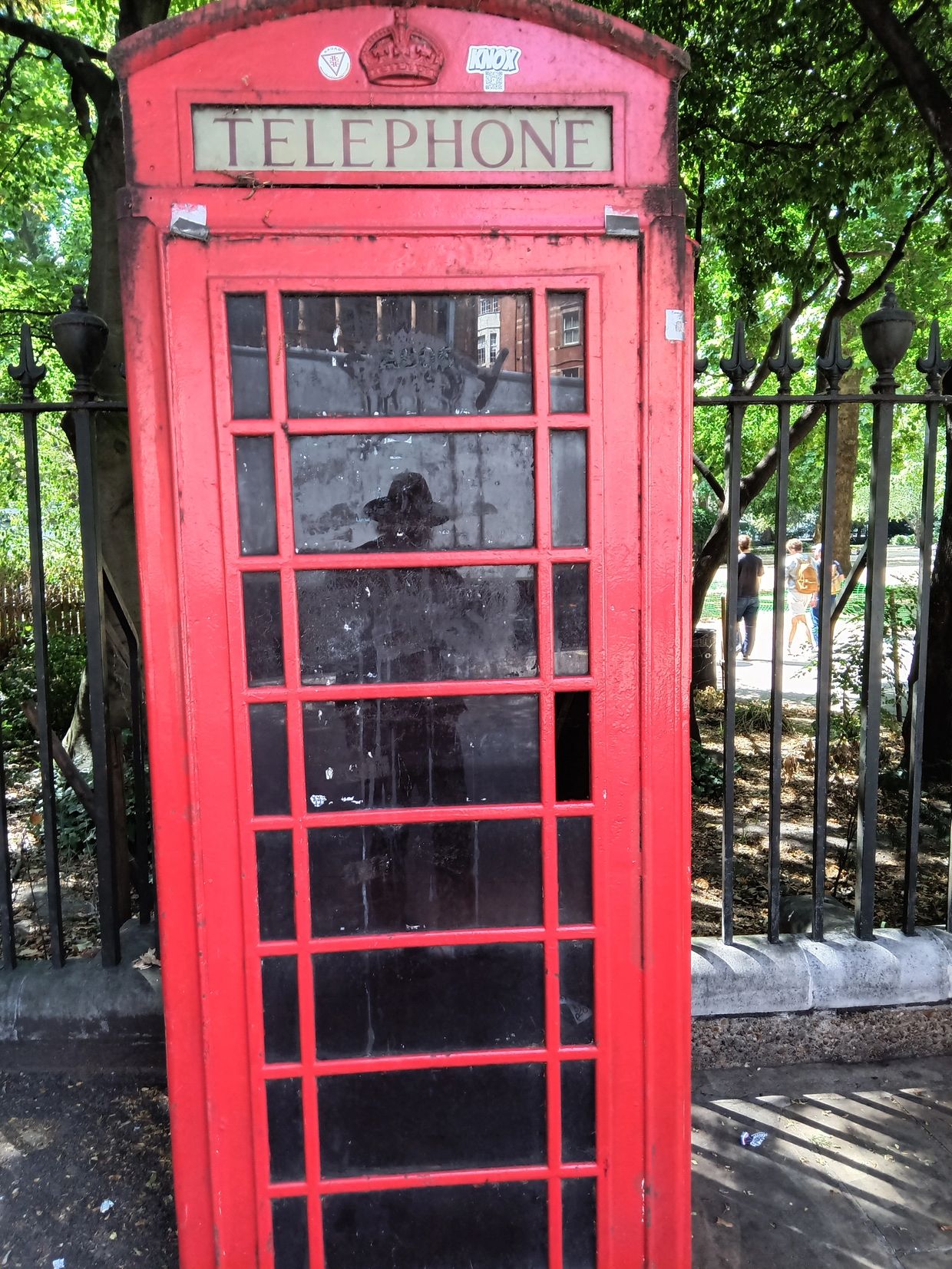
Red Phone Box, Russell Square, London, by Charles Swanson
A Miscellany of Joy
John C. Mannone
Happiness is a bird
a fickle bird that sings
when the weather is good
and hunkers down with fear
in its eyes when the storm
tries to un-nest her.
But Joy is also a bird
of different feathers
that shine in the daytime
sun even when the light
hides behind the clouds.
Happiness flits on branches
of my heart, which break
often, and it flees.
Joy roosts in the bosom
of my soul, it will never
leave, if I ask it to stay.
Happiness doesn’t twitter
and chirp when I am gone,
grief caught in its throat.
Joy is ruby-throated, a songbird
still rejoicing because I stayed
to remain in Him.
Poet’s Notes: A free verse antithesis using bird imagery as metaphors to compare and contrast Happiness and Joy.
About the Poet: John C. Mannone's work appears in Appalachian Journal, Artemis, Critical Humanities, Appalachia Bare, Red Branch Review, Poetry South, The Windhover, and others. Awarded the Jean Ritchie Fellowship (2017) in Appalachian literature, he authored six full-length collections (and six chapbooks), including the Weatherford Award-nominated Song of the Mountains (Middle Creek Publishing, 2023); and a top-eight finalist for the 2025 Tennessee Book Award, Sacred Flute (Iris Press, 2024). He's a retired professor of physics and the Poet Laureate for the City of Oak Ridge (2026-2028) in Tennessee.
********************
Ceili McCollonough
Do
Do fairies fly in summer skies,
On golden wings so high?
Do dragons make the fire burn and gather shiny things?
Of course, my child, in your dreams.
Where water turns to crystal ice,
Skated on by talking mice.
Visit your dreams, my child,
For there all is wild.
Sharks and seals together play,
Within a silver bay.
The ocean tastes honey sweet,
And milk salty as the sea.
My child enter your dreams,
When moonbeams beckon you to see
All your dreams can be.
About the Poet: McCollonough, Ceili, is a Tennessee author crafting emotionally resonant stories for teens and young adults. Her work blends lyrical prose, imaginative worlds, and art‑driven elements that invite young readers to explore identity, connection, and quiet magic.
********************
Mike Wahl
Stones to Dirt
Your gardening skills were what
everyone who knew you talked about -
how it wasn't just your thumb,
but it must be your whole body that was green
(though their view may have been tinged by envy).
Instead of coffee, it was always garden joys
and promises of the ground’s abundance
that got your mornings moving.
Sometimes we'd crawl side-by-side along the rows,
plucking out weeds from between infant carrot plants;
I'd complain about the stones and rocks,
but you assured me they'd eventually turn to dirt.
You saved seeds, traded seeds, and
planted seeds that you loved so much.
You loved your garden, perhaps as much as me,
and it's not quite fair that you left us both behind.
I weed the rows alone now, but I can feel you,
observantly pointing to the ones I miss.
The stones are still there, but they don't bother me,
especially the one I found today,
that was shaped like a heart - your heart?
I left it right where YOU left it,
there where it belongs, in your garden,
watching, waiting,
still encouraging all the plants to grow,
even weeds.
Poet’s Notes: The only part of this poem that is not factual is that my wife is still living, and still weeding, while I'm still learning.
About the Poet: Mike Wahl writes at his organic farm in northern Alabama, where he lives with his family. His short poems and stories examine the nuances of politics, nature, religion, & family, freely mixing fact and fiction. His short stories have appeared in several anthologies in recent years. He is the author of three published poetry works: Living Adverbially, Rooted in Christianity, and In Harmony with Homophones. Mike is being honored as the Poet of the Year for 2026, by the Alabama State Poetry Society.
********************
Laura Gunnells Miller
Columbine at Big Soddy Trailhead
Tucked in red
hero capes,
candy-yellow
microphones
drop
fragrant
joy into leafing
woodland—
loud and clear.
About the Poet: Laura Gunnells Miller is a writer and photographer from the mountains of southeast Tennessee. Her work appears in Tar River Poetry, Artemis Journal, Pine Mountain Sand & Gravel, Abyss & Apex Magazine, Salvation South, Art on the Trails (Southborough, Massachusetts), Ekphrastic Review, and elsewhere.
********************
Todd Matson
Dodging a Bullet at an ATM,
With a Little Help from Friends
They said Latinos coming
across the US border are
criminals, rapists, thieves,
murderers, drug dealers,
gang members, job stealers,
that we should be vigilant
around them, report any
suspicious activity. But I
digress. When I traveled
with my wife to Colombia
to visit with her family,
when I was exchanging
US dollars for Colombian
pesos at an ATM machine
and found myself walking
away studying the receipt
for the exchange rate,
international fee, foreign
ATM fee, at least twenty
Latino strangers in line
to get cash out suddenly
shouted out in unison for
me to return for my debit
card which I had left lying
in the ATM machine.
Poet’s Note: The poem . . . stems from a real-life experience.
About the Poet: Todd Matson is a Licensed Marriage and Family Therapist in North Carolina, United States. His writings have been published in Feminine Collective, Salvation South, Breathe, The Clayjar Review, Agape Review, Redrosethorns, San Antonio Review, The Brussels Review, The Shallot: Journal of Mental Health, Art, and Literature; WestWard Quarterly, Mobius: The Journal of Social Change, FEED THE HOLY; Faith, Hope and Fiction; Soul Poetry, Prose & Arts Magazine; Solid Food Press, Heart of Flesh Literary Journal, Neon and Smoke, Sublimation and Epistemic Literary Magazine. He has also written lyrics for songs recorded by several contemporary Christian music artists.
********************
Wendy Howe
Coming Home
We open the screen door
carrying you into the house
and your first days of life.
Shadows flutter on the curtain.
A sparrow tugs at a thread
trying to loosen it from the leaves
and a thicker vine.
The bird pulls tenaciously
despite the dense weight
of foliage and bark. He will not
relent or concede his efforts --
this string of plant
is needed to darn a nest, protect
its hatchlings And then, my beautiful son,
you stir to life. Your fist unfurls
grasping my finger. The room's light
widens its smile. Somehow, I sense
you will emulate this small
agile spirit, winged with wonder,
conquering the first tied shoe,
bicycle ride and baseball thrown
high into heaven's loft
of boundless blue --
all these moments
entangled with the tendrils
of my heart. The silhouette
of a birth cord that will never fade.
Poet’s Notes: This poem was inspired by my niece and her husband bringing their newborn home. In a conversation, she described the incredible joy they felt and certain things they noticed in the room. The sunlight intensified and a bird's shadow was seen fixing its nest. Psalm 84:3 came to mind: Even the sparrow has found a home, and the swallow a nest for herself, where she may have her young—a place near your altar, Lord Almighty, my King and my God. I contemplated how this young couple found their home in a small ranch blessed by The Lord and their deep commitment to family and faith.. A place to raise their child and cultivate his values through watching the tenacious creatures of God's natural world. My voice became her voice, sensing the affinity between the sparrow's determination and her growing son. All those milestones he would face with her support and maternal love connecting them for life.
About the Poet: Wendy Howe is an English teacher who lives in California. Her poetry reflects her interest in myth, women in conflict and history. Application of imagery, personal reflection and rhythmic language are basic elements of her writing style and expression. Over the years, she has been published in a variety of journals. Among them: Flowers of The Field, The Poetry Salzburg Review, The Interpreter's House, Indelible Magazine, The Orchards Journal, Songs of Eretz, Sun Dial Magazine, The Linnet's Wings and many others.
********************
Mari Fitz-Wynn
Raindrop Romp
“Come play,” the raindrops call,
beating against the panes.
“Let’s go!” you shout, and race around,
so out the door we run.
“It’s warm, and loud, it tickles!”
Your little bare feet splashing water on
my clothes, drenching my heart
with joy.
“Catch raindrops with your mouth,”
I say, smiling as your face turns to the sky.
Romp, stomp, twist, turn,
dance, partner with each drop.
You stop to watch the rain trace
each curve and groove
between your toes.
Giggling as it puddles,
and slowly disappears
somewhere beneath the soles
of your two brown happy
rain-soaked feet.
About the Poet: Mari Fitz-Wynn is an award-winning author of four creative non-fiction books, a poetry collection, RISE UP! Poems of Protest Poems of Praise. Her chapbook Dreamverse: The Poetry of Dreams is due out this year.
Her writing reflects her passion and commitment to exploring and writing about themes of resilience, justice, and personal growth. Mari connects with a global audience through her poignant and thought-provoking essays and poetry, published in numerous anthologies and magazines.
A United Arts Literary Grant recipient, she teaches virtual creative writing classes for the Muse Writers Center in Norfolk, VA. She has presented her creative writing workshop in Nairobi, Kenya, to the Writers Guild of Kenya. (2024)
Mari is the founder and managing editor of Faith Journey Publishing, a small press with a mission to create pathways to publishing for Women of Color over forty by amplifying underrepresented voices.
********************
Tyson West
Quitting Time
Though I may quit a job or end up fired,
the joy of being done burns just as bright.
I gave this work clear thought and time despite
my sense co-workers held back uninspired.
Though I may leave upset, sad, or desired,
I'll not return to labor, laugh, or fight.
If I decide to leave or end up fired,
the joy in finishing burns just as bright.
Some open office needs my passion hired,
where my imagination will delight
in problems begging for my shrewd insight.
My wit and wisdom will be much admired,
or I may choose to go, or end up fired.
Poet’s Notes: I have worked in a variety of jobs ranging from professional offices, to selling encyclopedias door to door and reroofing houses. I experienced at a young age the feelings of joy in finishing a job and leaving a position either voluntarily or involuntarily. Whether I tell the boss “I don’t fit in” or the boss tells me, the euphoria is the same in that I have an opportunity to move on to pastures new. The rondel is a perfect form to explore this theme. Since I have resigned and been let go numerous times in my life, the refrains echo the recurrence of this theme.
About the Poet: Tyson West has published speculative fiction and poetry in free verse, form verse and haiku distilled from his mystical relationship with noxious weeds and magpies in Eastern Washington. He has no plans to quit his day job in real estate. He was the featured USA poet at Muse Pie Press from December 2019 to December 2022. He placed third in the 2017 Kalathini Award contest with a rondel.
********************
Colette Tennant
Hallelujah
Hallelujah swoops like a swallow
guarding its obvious nest.
Hallelujah rolls like a sixteen-wheeler
with a load full of lambs.
Hallelujah wears a dress covered with starry spangles
and little pieces of the moon.
***
Colette Tennant
Mid-September and Dragon Begonias
in the side garden are a hieroglyph of endurance,
their sweetness decoded by the hummingbird
who sometimes greets me – hovers
until I say good morning, a quick-winged blessing.
No mention of even a shadow of fall.
No, here today, just sun and dragon begonias
and a hummingbird – shining hieroglyphs
for anyone who stops to notice.
About the Poet: Colette Tennant has three books of poetry: Commotion of Wings, Eden and After, and Sweet Gothic. Her book, Religion in The Handmaid’s Tale: a Brief Guide, was published in 2019 to coincide with Atwood’s publication of The Testaments. Her poems have won various awards and have been nominated for Pushcart Prizes along with being published in various journals, including Prairie Schooner, Rattle, Southern Poetry Review, and Poetry Ireland Review. Colette is an English and Humanities Professor who has also taught art in Great Britain, Germany, and Italy.
********************
Charles A. Swanson
Glory of Glories
What did they see? And what they saw,
how could they say what they saw?
“His face shone like the sun, and his clothes
became as white as light,”
and so they said. But that was poorly
said, a child’s stuttered words,
this change before their eyes, this Teacher—
not the same as every day.
This Jesus, whom they knew, or thought
they knew, whose words told them
more than they heard. Now he was more,
more than words, more than flesh.
And the light of glory was on him,
and they saw (oh, so briefly,
but forever burned into their eyes,
the eyes that dwell in the heart)
what they saw. What did they see,
what did they tell, what did
they know beyond knowing? That
the glory was Jesus himself.
And so he was transfigured, meta-
morphosed on that mountain,
or, no, he was not. He was only what
he was for all eternity.
(See the staff page for Swanson's biographical sketch.}
Poets
John C. Mannone
Ceili McCollonough
Mike Wah
Laura Gunnells Miller
Todd Matson
Wendy Howe
Mari Fitz-Wynn
Tyson West
Colette Tennant
Charles A. Swanson
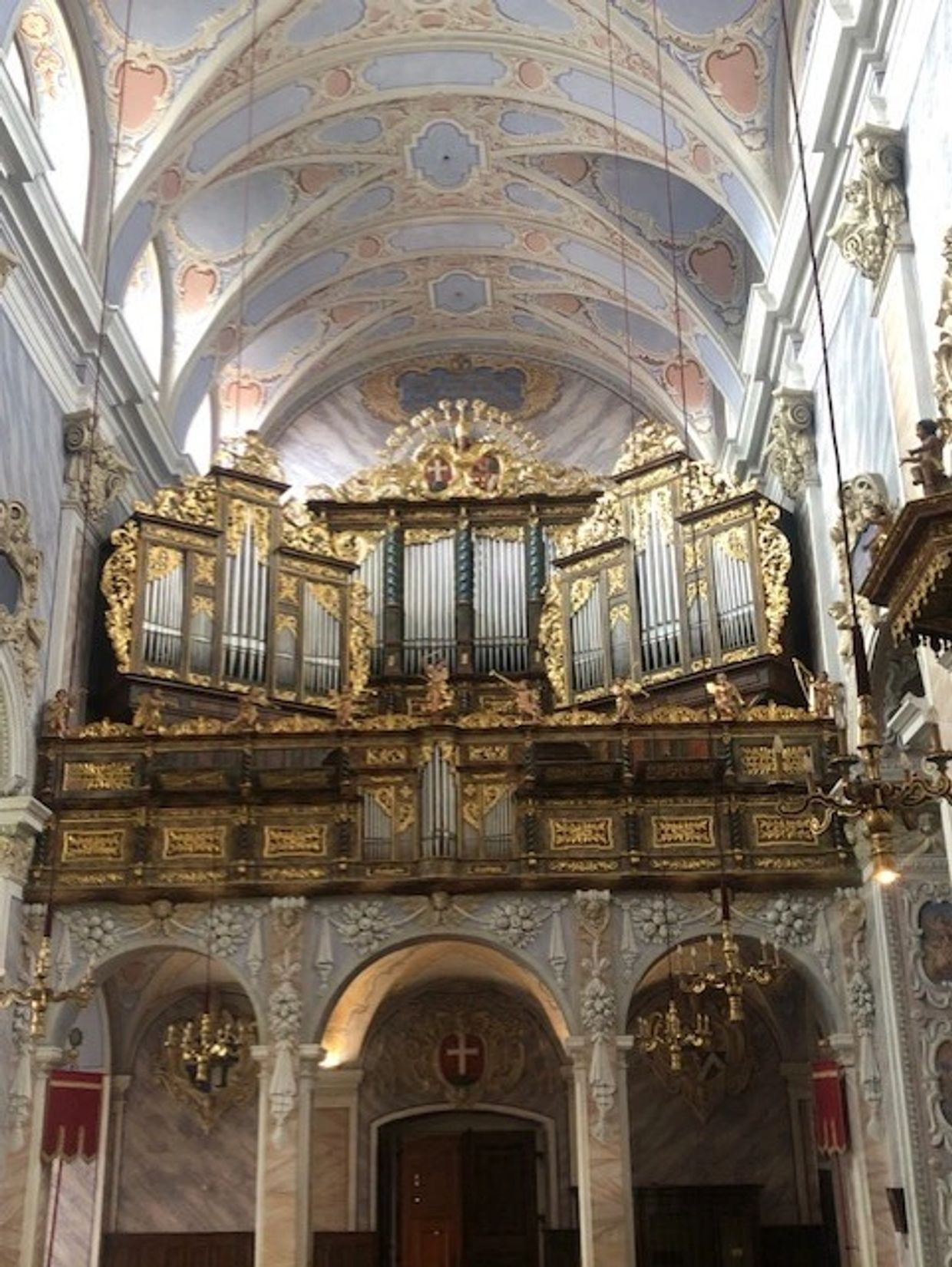
Cathedral Pipe Organ, Photo by Tracey Thiessen
Devotionals
John C. Mannone
Devotional on Joy and Happiness
Is there a difference? After studying languages, there’s no distinction between joy and happiness in the Bible (both Hebrew and Greek). In modern English, however, there is a significant difference— joy is internal, requires cultivation, and is everlasting; whereas happiness is external, it just happens, and is fleeting.
Abstractions are easier to understand in terms of concrete images, associations, or personifications. E.g., Light and Darkness are generalizations connecting Joy and Grief:
Light made the Darkness flee— a metaphorical paraphrase (Gen 1:3,4),
O Death where is your sting? (1Cor 15:55),
Jesus speaking, I am the light of the world, whoever follows me will never walk
in darkness but will have the light of life (John 8:12),
The light shines in the darkness, and the darkness has not overcome it (John 1:5),
MLK said, Darkness cannot drive out darkness, only light can do that
(“Loving Your Enemies” sermon).
Though there may be affliction/sadness, there’s still the hope of joy, which is renewed every morning (Lamentations 3:19-24). There’s a clear connection— night darkness with affliction/unhappiness, and morning light with joy.
Since both happiness and joy are emotional responses to our situation, they are not mutually exclusive. Recall the cliché “every cloud has a silver lining” (paraphrase of John Milton’s masque, Comus). Therefore, like a cloud, (un)happiness comes and goes, while joy is something from deep within us, that silver lining— a truth, a survival mechanism, a spiritual condition predicated on the knowledge of Christ.
Light and Darkness play heavily in the uplifting, Psalm 139: 7-12, through Hebraic poetry (parallelisms) we learn that God is everywhere, and with us. He gives us strength, especially in times of trouble (when enshrouded in darkness), because He is the Light in us. We are not the children of darkness (1 Thessalonians 5:5).
About the Writer: John C. Mannone's work appears in Appalachian Journal, Artemis, Critical Humanities, Appalachia Bare, Red Branch Review, Poetry South, The Windhover, and others. Awarded the Jean Ritchie Fellowship (2017) in Appalachian literature, he authored six full-length collections (and six chapbooks), including the Weatherford Award-nominated Song of the Mountains (Middle Creek Publishing, 2023); and a top-eight finalist for the 2025 Tennessee Book Award, Sacred Flute (Iris Press, 2024). He's a retired professor of physics and the Poet Laureate for the City of Oak Ridge (2026-2028) in Tennessee.
********************
Charles A. Swanson
Jesu, Joy of Man’s Desiring
My soul longs, yes, even faints For the courts of the LORD; My heart and my flesh cry out for the living God. Psalm 84:2, NKJV
As I played the piano, I thought of the crocheted doily that we keep on the piano’s polished black surface. It is small and white, with intricate twists and knots. We place nothing on top of the doily, although on other crocheted pieces we set artwork and pictures. This doily has deep significance because crocheted into the weave is the name, “Addi.” A high school friend of long ago, Carolyn Togger Yarosz, made the memorial and sent it to us when she learned of our sorrow. Addi, our granddaughter, died when she was seven of an e coli infection.
As I played, I thought about two other granddaughters, both who are learning to play the piano. When Addi died, she was older than they, and now they are older than she at the time of her passing. Addi’s other grandmother had begun working with her on a few simple songs, but I never had the opportunity to sit beside her on the piano bench.
As I played “Jesu, Joy of Man’s Desiring,” a song that brings me peace and a sense of God’s presence, I imagined Addi as a piano student. She was a smart girl and she learned easily. I also remembered her words to our daughter, as she was suffering in excruciating pain, “Momma, I don’t want to die.”
Those conflicting emotions rushed through me, battering against each other. Tearfully, I kept playing, letting the music thread and bind my soul’s cries to my Comforter. He receives my pain in the middle of my joy.
(See the Staff page for Swanson's biographical sketch.)
Writers
John C. Mannone
Charles A. Swanson